Acids, Bases and Salts — Class 10 CBSE Science revision notes
A 6-page visual revision sheet for Acids, Bases and Salts, written for Class 10 CBSE Science. Formulas, diagrams and the traps that cost marks, laid out to be read the night before rather than the term before. Free, and it opens inside CapCompass.
 Page 1 as PDF
Acids, Bases and Salts in one look
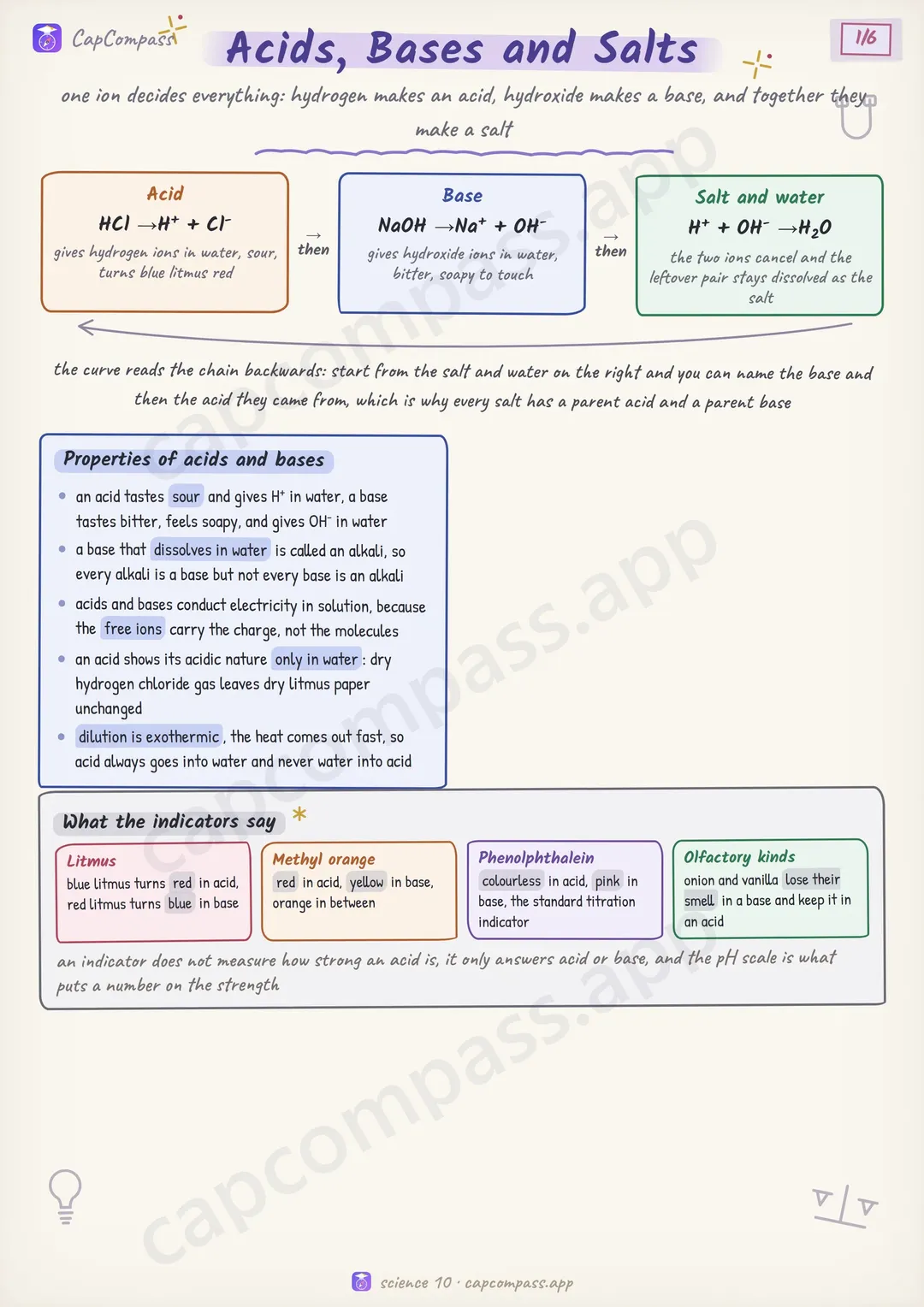
one ion decides everything: hydrogen makes an acid, hydroxide makes a base, and together they make a salt
- Acid: gives hydrogen ions in water, sour, turns blue litmus red
- Base: gives hydroxide ions in water, bitter, soapy to touch
- Salt and water: the two ions cancel and the leftover pair stays dissolved as the salt
Properties of acids and bases
- an acid tastes sour and gives H^+ in water, a base tastes bitter, feels soapy, and gives OH^- in water
- a base that dissolves in water is called an alkali, so every alkali is a base but not every base is an alkali
- acids and bases conduct electricity in solution, because the free ions carry the charge, not the molecules
- an acid shows its acidic nature only in water: dry hydrogen chloride gas leaves dry litmus paper unchanged
- dilution is exothermic, the heat comes out fast, so acid always goes into water and never water into acid
What the indicators say
- Litmus: blue litmus turns red in acid, red litmus turns blue in base
- Methyl orange: red in acid, yellow in base, orange in between
- Phenolphthalein: colourless in acid, pink in base, the standard titration indicator
- Olfactory kinds: onion and vanilla lose their smell in a base and keep it in an acid
Page 1 of 6. The full sheet, all 6 pages, opens free in the app.
What this Acids, Bases and Salts sheet covers
- Acid
- Base
- Salt and water
- Indicators
- Chemical properties of acids and bases
- Properties of acids and bases
- What the indicators say
- Litmus
- Methyl orange
- Phenolphthalein
- Olfactory kinds
- Strong and weak, concentrated and dilute
- Strong or weak
- Concentrated or dilute
- Reaction of acids with metals
- Metal carbonate
- Reactions of acids
- acid + metal gives salt + hydrogen
- acid + metal carbonate gives salt + water + carbon dioxide
- acid + metal hydrogencarbonate, the same three products
- acid + metal oxide gives salt + water, a basic oxide neutralised
- acid + base gives salt + water
- Reactions of bases
- base + non-metal oxide gives salt + water, an acidic oxide neutralised
- base + metal, only some metals, and the gas is hydrogen again
- the limewater test, and the milkiness is the precipitate
- excess carbon dioxide dissolves the milkiness away again
- Testing the gas that came off
- Neutralisation is an ion cancelling out
- pH scale
- Strength of acid or base
- The pH scale
- pH as a power of ten
- Importance of pH in everyday life
- pH in everyday life
- Family of salts
- pH of salts
- Salts and their family
- Chlor-alkali process
- Bleaching powder
- Baking soda
- Washing soda
- Common salt and the chemicals made from it
- electrolysis of brine, the chlor-alkali process
- bleaching powder, from chlorine and dry slaked lime
- baking soda, sodium hydrogencarbonate
- heating baking soda, which is what makes a cake rise
- washing soda, by recrystallising sodium carbonate
- Salts and their uses
- What each one is used for
- Plaster of Paris
- Water of crystallisation
- Traps that cost marks
- Tricks that save time
How CapCompass uses this sheet
These notes are not a standalone PDF. CapCompass plans Science chapter by chapter against your real exam dates and free hours, and when the plan reaches Acids, Bases and Salts the sheet opens inside the study block itself — at the page covering the sub-topic that block is on, with the timer still running. Revision arrives at the moment the plan says revise, instead of having to be gone looking for.