Metals and Non-metals — Class 10 CBSE Science revision notes
A 5-page visual revision sheet for Metals and Non-metals, written for Class 10 CBSE Science. Formulas, diagrams and the traps that cost marks, laid out to be read the night before rather than the term before. Free, and it opens inside CapCompass.
 Page 1 as PDF
Metals and Non-metals in one look
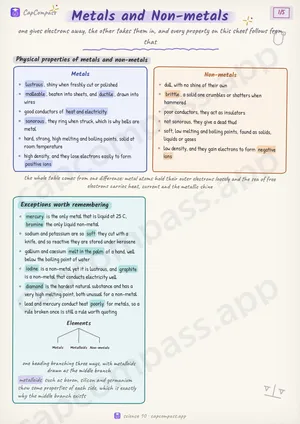
one gives electrons away, the other takes them in, and every property on this sheet follows from that
Physical properties of metals and non-metals
- lustrous, shiny when freshly cut or polished
- malleable, beaten into sheets, and ductile, drawn into wires
- good conductors of heat and electricity
- sonorous, they ring when struck, which is why bells are metal
- hard, strong, high melting and boiling points, solid at room temperature
- high density, and they lose electrons easily to form positive ions
- dull, with no shine of their own
- brittle, a solid one crumbles or shatters when hammered
- poor conductors, they act as insulators
- not sonorous, they give a dead thud
- soft, low melting and boiling points, found as solids, liquids or gases
- low density, and they gain electrons to form negative ions
Exceptions worth remembering
- mercury is the only metal that is liquid at 25 C, bromine the only liquid non-metal
- sodium and potassium are so soft they cut with a knife, and so reactive they are stored under kerosene
- gallium and caesium melt in the palm of a hand, well below the boiling point of water
- iodine is a non-metal yet it is lustrous, and graphite is a non-metal that conducts electricity well
- diamond is the hardest natural substance and has a very high melting point, both unusual for a non-metal
- lead and mercury conduct heat poorly for metals, so a rule broken once is still a rule worth quoting
Page 1 of 5. The full sheet, all 5 pages, opens free in the app.
What this Metals and Non-metals sheet covers
- Physical properties
- Physical properties of metals and non-metals
- Metals
- Non-metals
- Exceptions worth remembering
- Reaction of metals with oxygen
- Reaction with water
- Reaction with acids
- Chemical properties of metals
- metal + oxygen gives a basic metal oxide
- the very reactive ones, with cold water
- calcium with water, and the bubbles make it float
- iron needs steam, not cold water
- metal + dilute acid gives salt + hydrogen
- metal + salt solution, the displacement test
- Amphoteric oxides
- Activity series
- Displacement of metals
- Reactivity series and displacement
- Reactivity read as electron loss
- Chemical properties of non-metals
- Ionic compounds
- Formation of ionic compounds
- Ionic bonding
- Properties of ionic compounds
- Corrosion
- Prevention of corrosion
- Corrosion and its prevention
- Why an alloy is harder than the pure metal
- Ore
- Metal oxide
- Pure metal
- Extraction of metals
- Metallurgy
- Roasting and calcination
- Occurrence and extraction of metals
- roasting, a sulphide ore heated strongly in air
- calcination, a carbonate ore heated with little air
- reduction of the oxide by carbon, for the middle metals
- electrolysis of a molten salt, for the most reactive metals
- the thermite reaction, which welds cracked rails on the spot
- Words used here
- Traps that cost marks
- Tricks that save time
How CapCompass uses this sheet
These notes are not a standalone PDF. CapCompass plans Science chapter by chapter against your real exam dates and free hours, and when the plan reaches Metals and Non-metals the sheet opens inside the study block itself — at the page covering the sub-topic that block is on, with the timer still running. Revision arrives at the moment the plan says revise, instead of having to be gone looking for.