Grammar — Class 11 CBSE English revision notes
A 4-page visual revision sheet for Grammar, written for Class 11 CBSE English. Formulas, diagrams and the traps that cost marks, laid out to be read the night before rather than the term before. Free, and it opens inside CapCompass.
 Page 1 as PDF
Grammar in one look
the rules that hold a sentence together, drilled till they're reflex
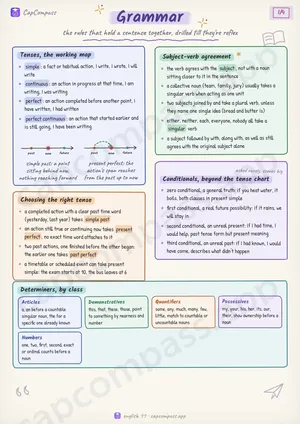
Tenses, the working map
- simple: a fact or habitual action, I write, I wrote, I will write
- continuous: an action in progress at that time, I am writing, I was writing
- perfect: an action completed before another point, I have written, I had written
- perfect continuous: an action that started earlier and is still going, I have been writing
Choosing the right tense
- a completed action with a clear past time word (yesterday, last year) takes simple past
- an action still true or continuing now takes present perfect, no exact time word attaches to it
- two past actions, one finished before the other began: the earlier one takes past perfect
- a timetable or scheduled event can take present simple: the exam starts at 10, the bus leaves at 6
Subject-verb agreement
- the verb agrees with the subject, not with a noun sitting closer to it in the sentence
- a collective noun (team, family, jury) usually takes a singular verb when acting as one unit
- two subjects joined by and take a plural verb, unless they name one single idea (bread and butter is)
- either, neither, each, everyone, nobody all take a singular verb
- a subject followed by with, along with, as well as still agrees with the original subject alone
Conditionals, beyond the tense chart
- zero conditional, a general truth: if you heat water, it boils, both clauses in present simple
- first conditional, a real future possibility: if it rains, we will stay in
- second conditional, an unreal present: if I had time, I would help, past tense form but present meaning
- third conditional, an unreal past: if I had known, I would have come, describes what didn't happen
Determiners, by class
- Articles: a, an before a countable singular noun, the for a specific one already known
- Demonstratives: this, that, these, those, point to something by nearness and number
- Quantifiers: some, any, much, many, few, little, match to countable or uncountable nouns
- Possessives: my, your, his, her, its, our, their, show ownership before a noun
- Numbers: one, two, first, second, exact or ordinal counts before a noun
Page 1 of 4. The full sheet, all 4 pages, opens free in the app.
What this Grammar sheet covers
- Tenses, the working map
- Choosing the right tense
- Subject-verb agreement
- Conditionals, beyond the tense chart
- Determiners, by class
- Articles
- Demonstratives
- Quantifiers
- Possessives
- Numbers
- Determiners that trip students
- Modals, meaning by function
- Ability, possibility
- Obligation, advice
- Modals in reported speech
- Common determiner and modal slips
- Active to passive, the four steps
- 1
- 2
- 3
- 4
- Voice, worked examples
- Direct to reported speech, what shifts
- Reported speech, tense backshift map
- Error correction, the checklist
- Editing an underlined error
- Direct to reported speech, fully worked
- Traps that cost marks
- Tricks that save time
How CapCompass uses this sheet
These notes are not a standalone PDF. CapCompass plans English chapter by chapter against your real exam dates and free hours, and when the plan reaches Grammar the sheet opens inside the study block itself — at the page covering the sub-topic that block is on, with the timer still running. Revision arrives at the moment the plan says revise, instead of having to be gone looking for.