Reading Comprehension — Class 11 CBSE English revision notes
A 5-page visual revision sheet for Reading Comprehension, written for Class 11 CBSE English. Formulas, diagrams and the traps that cost marks, laid out to be read the night before rather than the term before. Free, and it opens inside CapCompass.
 Page 1 as PDF
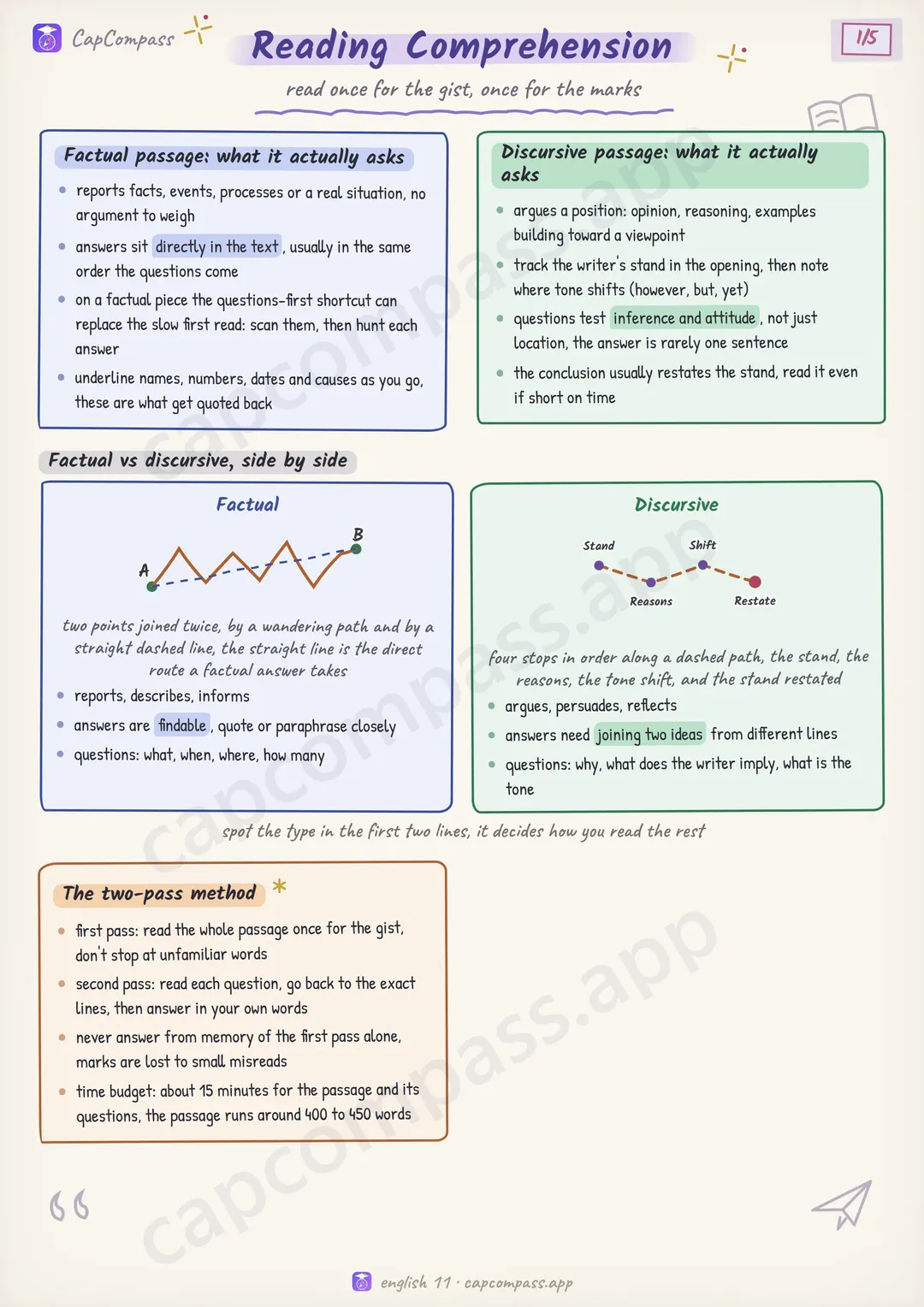
Reading Comprehension in one look
read once for the gist, once for the marks
Factual passage: what it actually asks
- reports facts, events, processes or a real situation, no argument to weigh
- answers sit directly in the text, usually in the same order the questions come
- on a factual piece the questions-first shortcut can replace the slow first read: scan them, then hunt each answer
- underline names, numbers, dates and causes as you go, these are what get quoted back
Discursive passage: what it actually asks
- argues a position: opinion, reasoning, examples building toward a viewpoint
- track the writer's stand in the opening, then note where tone shifts (however, but, yet)
- questions test inference and attitude, not just location, the answer is rarely one sentence
- the conclusion usually restates the stand, read it even if short on time
Factual vs discursive, side by side
- reports, describes, informs
- answers are findable, quote or paraphrase closely
- questions: what, when, where, how many
- argues, persuades, reflects
- answers need joining two ideas from different lines
- questions: why, what does the writer imply, what is the tone
The two-pass method
- first pass: read the whole passage once for the gist, don't stop at unfamiliar words
- second pass: read each question, go back to the exact lines, then answer in your own words
- never answer from memory of the first pass alone, marks are lost to small misreads
- time budget: about 15 minutes for the passage and its questions, the passage runs around 400 to 450 words
Page 1 of 5. The full sheet, all 5 pages, opens free in the app.
What this Reading Comprehension sheet covers
- Factual passage: what it actually asks
- Discursive passage: what it actually asks
- Factual vs discursive, side by side
- Factual
- Discursive
- The two-pass method
- Question types and what each one wants
- Note making, the format that scores
- Title
- Numbering
- Indentation
- Abbreviations
- Key/abbreviations list
- Note making, the rules that carry marks
- Summary, the rules that carry marks
- Building the summary from the notes
- Vocabulary in context
- Working out an unfamiliar word
- Inference: reading what isn't said
- Answering an inferential question, one example fully worked
- Traps that cost marks
- Tricks that save time
How CapCompass uses this sheet
These notes are not a standalone PDF. CapCompass plans English chapter by chapter against your real exam dates and free hours, and when the plan reaches Reading Comprehension the sheet opens inside the study block itself — at the page covering the sub-topic that block is on, with the timer still running. Revision arrives at the moment the plan says revise, instead of having to be gone looking for.