Grammar — Class 12 CBSE English revision notes
A 3-page visual revision sheet for Grammar, written for Class 12 CBSE English. Formulas, diagrams and the traps that cost marks, laid out to be read the night before rather than the term before. Free, and it opens inside CapCompass.
 Page 1 as PDF
Grammar in one look
the integrated items: gap fills, error spotting, transformation, and the tenses that decide all three
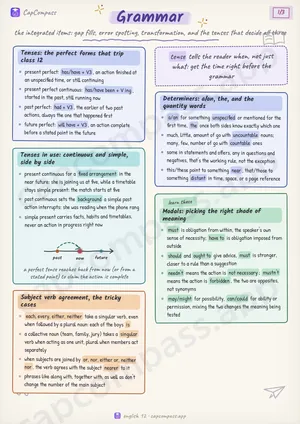
Tenses: the perfect forms that trip class 12
- present perfect: has/have + V3, an action finished at an unspecified time, or still continuing
- present perfect continuous: has/have been + V ing, started in the past, still running now
- past perfect: had + V3, the earlier of two past actions, always the one that happened first
- future perfect: will have + V3, an action complete before a stated point in the future
Tenses in use: continuous and simple, side by side
- present continuous for a fixed arrangement in the near future: she is joining us at five, while a timetable stays simple present: the match starts at five
- past continuous sets the background a simple past action interrupts: she was reading when the phone rang
- simple present carries facts, habits and timetables, never an action in progress right now
Subject verb agreement, the tricky cases
- each, every, either, neither take a singular verb, even when followed by a plural noun: each of the boys is
- a collective noun (team, family, jury) takes a singular verb when acting as one unit, plural when members act separately
- when subjects are joined by or, nor, either or, neither nor, the verb agrees with the subject nearer to it
- phrases like along with, together with, as well as don't change the number of the main subject
Determiners: a/an, the, and the quantity words
- a/an for something unspecified or mentioned for the first time, the once both sides know exactly which one
- much, little, amount of go with uncountable nouns; many, few, number of go with countable ones
- some in statements and offers, any in questions and negatives, that's the working rule, not the exception
- this/these point to something near, that/those to something distant in time, space, or a page reference
Modals: picking the right shade of meaning
- must is obligation from within, the speaker's own sense of necessity; have to is obligation imposed from outside
- should and ought to give advice, must is stronger, closer to a rule than a suggestion
- needn't means the action is not necessary; mustn't means the action is forbidden, the two are opposites, not synonyms
- may/might for possibility, can/could for ability or permission, mixing the two changes the meaning being tested
Page 1 of 3. The full sheet, all 3 pages, opens free in the app.
What this Grammar sheet covers
- Tenses: the perfect forms that trip class 12
- Tenses in use: continuous and simple, side by side
- Subject verb agreement, the tricky cases
- Determiners: a/an, the, and the quantity words
- Modals: picking the right shade of meaning
- Modals in reported speech, the ones that never move
- Voice: active to passive, what actually changes
- Narration: reported speech, the moving parts
- Error correction & editing, the exam format
- Terms worth knowing cold
- Voice and narration, what carries over
- Active to passive
- Direct to reported
- Traps that cost marks
- Tricks that save time
How CapCompass uses this sheet
These notes are not a standalone PDF. CapCompass plans English chapter by chapter against your real exam dates and free hours, and when the plan reaches Grammar the sheet opens inside the study block itself — at the page covering the sub-topic that block is on, with the timer still running. Revision arrives at the moment the plan says revise, instead of having to be gone looking for.