Reading Comprehension — Class 12 CBSE English revision notes
A 4-page visual revision sheet for Reading Comprehension, written for Class 12 CBSE English. Formulas, diagrams and the traps that cost marks, laid out to be read the night before rather than the term before. Free, and it opens inside CapCompass.
 Page 1 as PDF
Reading Comprehension in one look
two passages, one with charts, and the marks that hide in reading it right the first time
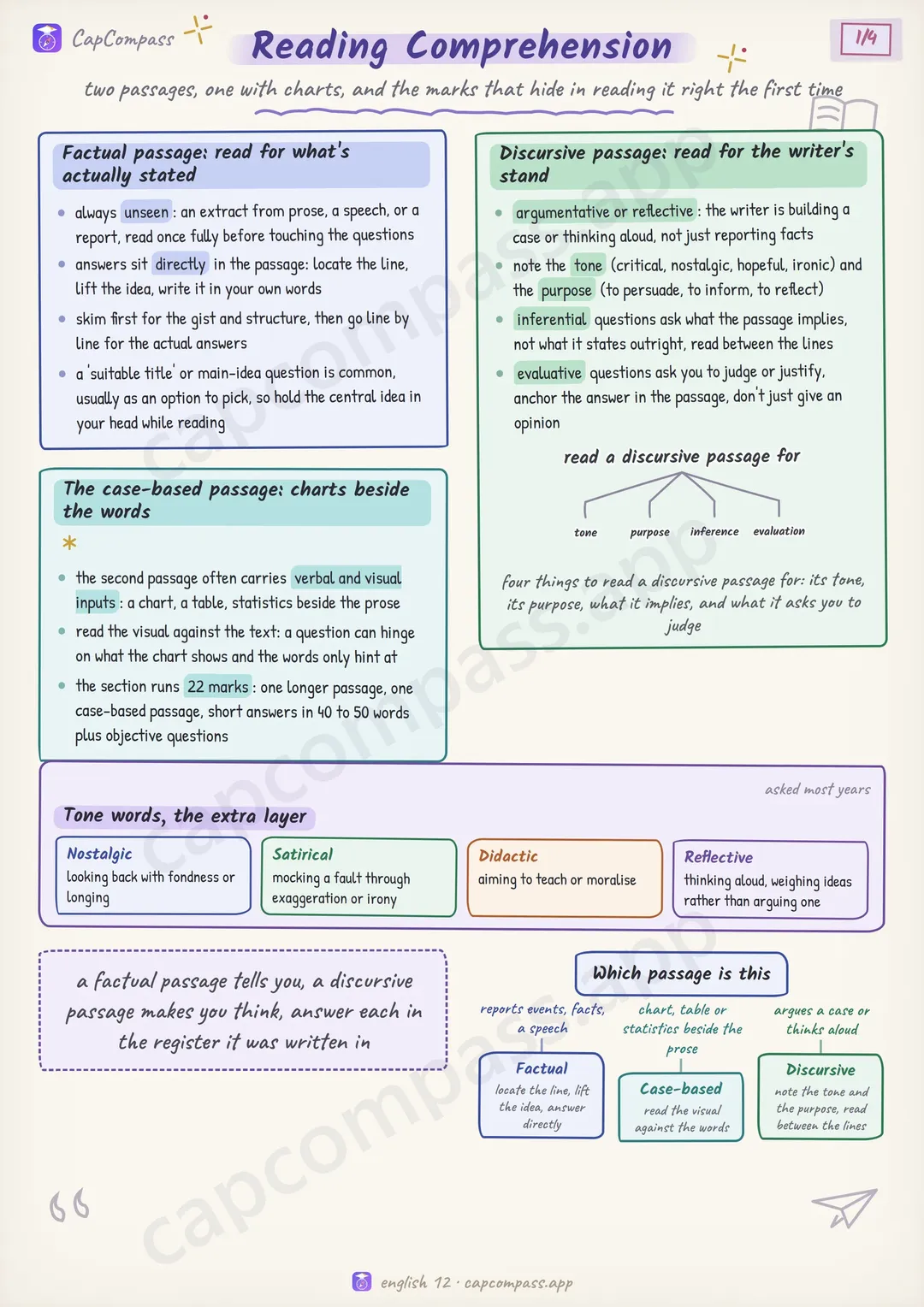
Factual passage: read for what's actually stated
- always unseen: an extract from prose, a speech, or a report, read once fully before touching the questions
- answers sit directly in the passage: locate the line, lift the idea, write it in your own words
- skim first for the gist and structure, then go line by line for the actual answers
- a 'suitable title' or main-idea question is common, usually as an option to pick, so hold the central idea in your head while reading
The case-based passage: charts beside the words
- the second passage often carries verbal and visual inputs: a chart, a table, statistics beside the prose
- read the visual against the text: a question can hinge on what the chart shows and the words only hint at
- the section runs 22 marks: one longer passage, one case-based passage, short answers in 40 to 50 words plus objective questions
Discursive passage: read for the writer's stand
- argumentative or reflective: the writer is building a case or thinking aloud, not just reporting facts
- note the tone (critical, nostalgic, hopeful, ironic) and the purpose (to persuade, to inform, to reflect)
- inferential questions ask what the passage implies, not what it states outright, read between the lines
- evaluative questions ask you to judge or justify, anchor the answer in the passage, don't just give an opinion
Tone words, the extra layer
- Nostalgic: looking back with fondness or longing
- Satirical: mocking a fault through exaggeration or irony
- Didactic: aiming to teach or moralise
- Reflective: thinking aloud, weighing ideas rather than arguing one
Which passage is this
- reports events, facts, a speech — Factual: locate the line, lift the idea, answer directly
- chart, table or statistics beside the prose — Case-based: read the visual against the words
- argues a case or thinks aloud — Discursive: note the tone and the purpose, read between the lines
Page 1 of 4. The full sheet, all 4 pages, opens free in the app.
What this Reading Comprehension sheet covers
- Factual passage: read for what's actually stated
- The case-based passage: charts beside the words
- Discursive passage: read for the writer's stand
- Tone words, the extra layer
- Nostalgic
- Satirical
- Didactic
- Reflective
- Note making, the format that scores
- Abbreviation key, non-negotiable
- Summary: the note, turned into prose
- Note vs summary, same passage, two shapes
- Note
- Summary
- Vocabulary in context: read the sentence, not the dictionary
- Word class: what the question is actually asking
- Terms worth knowing cold
- Answering an inferential question
- Traps that cost marks
- Tricks that save time
How CapCompass uses this sheet
These notes are not a standalone PDF. CapCompass plans English chapter by chapter against your real exam dates and free hours, and when the plan reaches Reading Comprehension the sheet opens inside the study block itself — at the page covering the sub-topic that block is on, with the timer still running. Revision arrives at the moment the plan says revise, instead of having to be gone looking for.