Human Reproduction — Class 12 ISC Biology revision notes
A 4-page visual revision sheet for Human Reproduction, written for Class 12 ISC Biology. Formulas, diagrams and the traps that cost marks, laid out to be read the night before rather than the term before. Free, and it opens inside CapCompass.
 Page 1 as PDF
Human Reproduction in one look
two systems, two cycles, and the timeline from fusion to birth
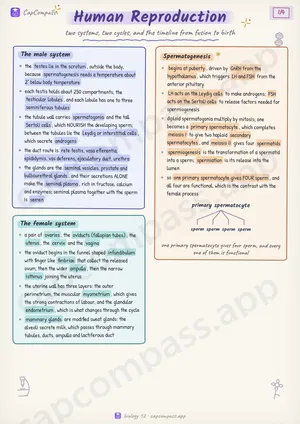
The male system
- the testes lie in the scrotum, outside the body, because spermatogenesis needs a temperature about 2 degrees below body temperature
- each testis holds about 250 compartments, the testicular lobules, and each lobule has one to three seminiferous tubules
- the tubule wall carries spermatogonia and the tall Sertoli cells, which NOURISH the developing sperm; between the tubules lie the Leydig or interstitial cells, which secrete androgens
- the duct route is rete testis, vasa efferentia, epididymis, vas deferens, ejaculatory duct, urethra
- the glands are the seminal vesicles, prostate and bulbourethral glands, and their secretions ALONE make the seminal plasma, rich in fructose, calcium and enzymes; seminal plasma together with the sperm is semen
The female system
- a pair of ovaries, the oviducts (fallopian tubes), the uterus, the cervix and the vagina
- the oviduct begins in the funnel shaped infundibulum with finger like fimbriae that collect the released ovum, then the wider ampulla, then the narrow isthmus joining the uterus
- the uterine wall has three layers: the outer perimetrium, the muscular myometrium, which gives the strong contractions of labour, and the glandular endometrium, which is what changes through the cycle
- mammary glands are modified sweat glands: the alveoli secrete milk, which passes through mammary tubules, ducts, ampulla and lactiferous duct
Spermatogenesis
- begins at puberty, driven by GnRH from the hypothalamus, which triggers LH and FSH from the anterior pituitary
- LH acts on the Leydig cells to make androgens; FSH acts on the Sertoli cells to release factors needed for spermiogenesis
- diploid spermatogonia multiply by mitosis; one becomes a primary spermatocyte, which completes meiosis I to give two haploid secondary spermatocytes, and meiosis II gives four spermatids
- spermiogenesis is the transformation of a spermatid into a sperm; spermiation is its release into the lumen
- so one primary spermatocyte gives FOUR sperm, and all four are functional, which is the contrast with the female process
Page 1 of 4. The full sheet, all 4 pages, opens free in the app.
What this Human Reproduction sheet covers
- The male system
- The female system
- Spermatogenesis
- Oogenesis, and the long pause in the middle
- The sperm and the ovum, structurally
- The menstrual cycle, day by day
- Fertilisation, and the block against a second sperm
- Cleavage, implantation and the placenta
- The pregnancy timeline worth memorising
- Lactation, and the first milk
- The two gametogeneses, side by side
- The hormones, and what each one does
- Why the corpus luteum does not die in pregnancy
- Traps that cost marks
- Tricks that save time
How CapCompass uses this sheet
These notes are not a standalone PDF. CapCompass plans Biology chapter by chapter against your real exam dates and free hours, and when the plan reaches Human Reproduction the sheet opens inside the study block itself — at the page covering the sub-topic that block is on, with the timer still running. Revision arrives at the moment the plan says revise, instead of having to be gone looking for.