Sexual Reproduction in Flowering Plants — Class 12 ISC Biology revision notes
A 4-page visual revision sheet for Sexual Reproduction in Flowering Plants, written for Class 12 ISC Biology. Formulas, diagrams and the traps that cost marks, laid out to be read the night before rather than the term before. Free, and it opens inside CapCompass.
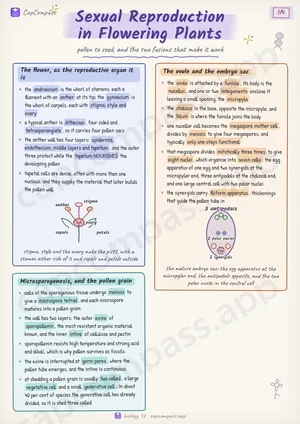 Page 1 as PDF
Sexual Reproduction in Flowering Plants in one look
pollen to seed, and the two fusions that make it work
The flower, as the reproductive organ it is
- the androecium is the whorl of stamens, each a filament with an anther at its tip; the gynoecium is the whorl of carpels, each with stigma, style and ovary
- a typical anther is dithecous, four sided and tetrasporangiate, so it carries four pollen sacs
- the anther wall has four layers: epidermis, endothecium, middle layers and tapetum, and the outer three protect while the tapetum NOURISHES the developing pollen
- tapetal cells are dense, often with more than one nucleus, and they supply the material that later builds the pollen wall
Microsporogenesis, and the pollen grain
- cells of the sporogenous tissue undergo meiosis to give a microspore tetrad, and each microspore matures into a pollen grain
- the wall has two layers: the outer exine of sporopollenin, the most resistant organic material known, and the inner intine of cellulose and pectin
- sporopollenin resists high temperature and strong acid and alkali, which is why pollen survives as fossils
- the exine is interrupted at germ pores, where the pollen tube emerges, and the intine is continuous
- at shedding a pollen grain is usually two celled, a large vegetative cell and a small generative cell; in about 40 per cent of species the generative cell has already divided, so it is shed three celled
The ovule and the embryo sac
- the ovule is attached by a funicle, its body is the nucellus, and one or two integuments enclose it leaving a small opening, the micropyle
- the chalaza is the base, opposite the micropyle, and the hilum is where the funicle joins the body
- one nucellar cell becomes the megaspore mother cell, divides by meiosis to give four megaspores, and typically only one stays functional
- that megaspore divides mitotically three times to give eight nuclei, which organise into seven cells: the egg apparatus of one egg and two synergids at the micropylar end, three antipodals at the chalazal end, and one large central cell with two polar nuclei
- the synergids carry filiform apparatus, thickenings that guide the pollen tube in
Page 1 of 4. The full sheet, all 4 pages, opens free in the app.
What this Sexual Reproduction in Flowering Plants sheet covers
- The flower, as the reproductive organ it is
- Microsporogenesis, and the pollen grain
- The ovule and the embryo sac
- pre-fertilisation
- pre fertilisation
- Pollination, and the three kinds by source
- Agents of pollination, and what each flower advertises
- Outbreeding devices
- Pollen pistil interaction, and the journey down the style
- Double fertilisation, the event unique to this group
- Endosperm and embryo
- Seed and fruit, part by part
- Apomixis and polyembryony
- The numbers questions turn on
- Perisperm, the tissue that is not endosperm
- Traps that cost marks
- Tricks that save time
How CapCompass uses this sheet
These notes are not a standalone PDF. CapCompass plans Biology chapter by chapter against your real exam dates and free hours, and when the plan reaches Sexual Reproduction in Flowering Plants the sheet opens inside the study block itself — at the page covering the sub-topic that block is on, with the timer still running. Revision arrives at the moment the plan says revise, instead of having to be gone looking for.