Nationalism in India — Class 10 CBSE Social Science revision notes
A 6-page visual revision sheet for Nationalism in India, written for Class 10 CBSE Social Science. Formulas, diagrams and the traps that cost marks, laid out to be read the night before rather than the term before. Free, and it opens inside CapCompass.
 Page 1 as PDF
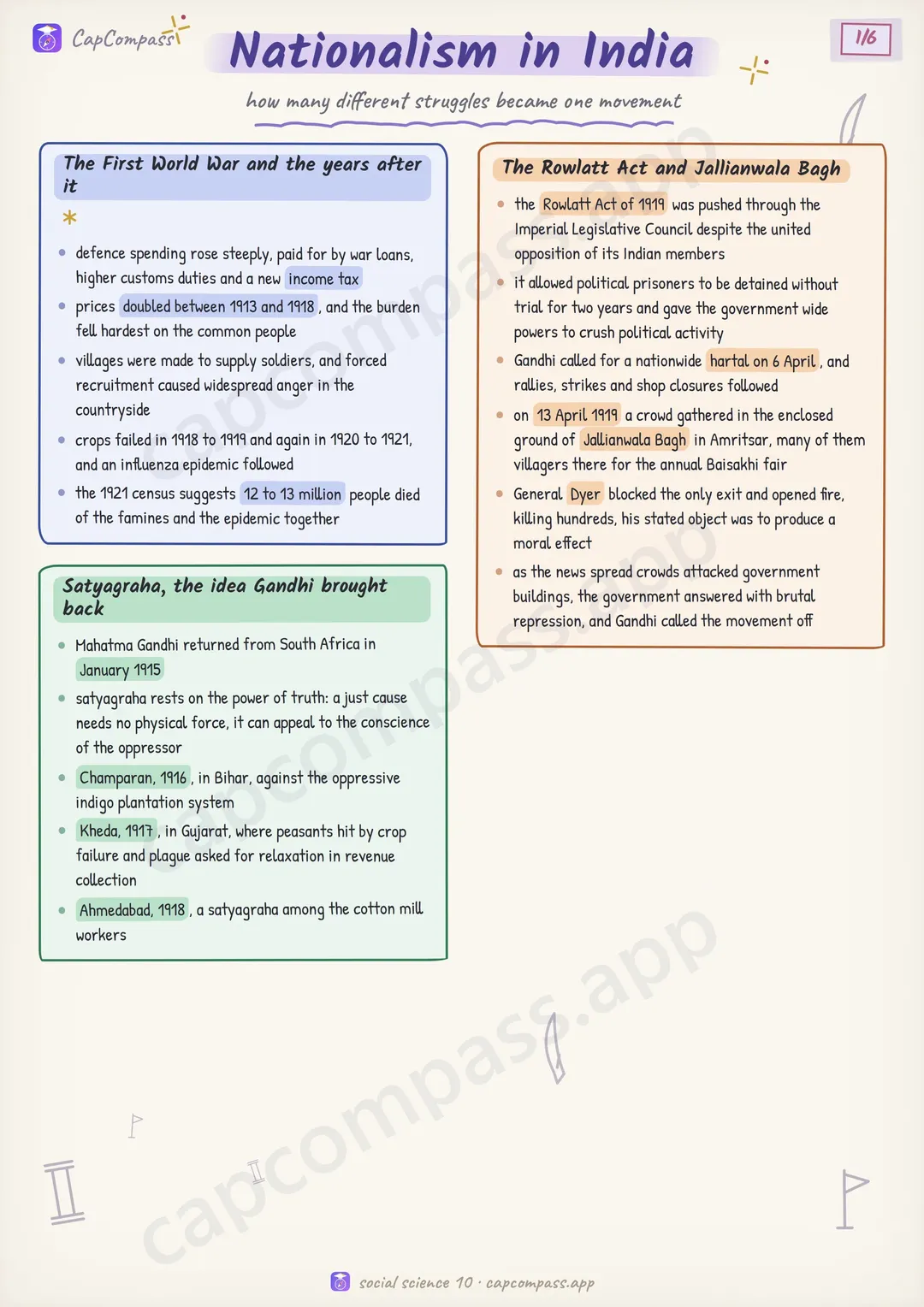
Nationalism in India in one look
how many different struggles became one movement
The First World War and the years after it
- defence spending rose steeply, paid for by war loans, higher customs duties and a new income tax
- prices doubled between 1913 and 1918, and the burden fell hardest on the common people
- villages were made to supply soldiers, and forced recruitment caused widespread anger in the countryside
- crops failed in 1918 to 1919 and again in 1920 to 1921, and an influenza epidemic followed
- the 1921 census suggests 12 to 13 million people died of the famines and the epidemic together
Satyagraha, the idea Gandhi brought back
- Mahatma Gandhi returned from South Africa in January 1915
- satyagraha rests on the power of truth: a just cause needs no physical force, it can appeal to the conscience of the oppressor
- Champaran, 1916, in Bihar, against the oppressive indigo plantation system
- Kheda, 1917, in Gujarat, where peasants hit by crop failure and plague asked for relaxation in revenue collection
- Ahmedabad, 1918, a satyagraha among the cotton mill workers
The Rowlatt Act and Jallianwala Bagh
- the Rowlatt Act of 1919 was pushed through the Imperial Legislative Council despite the united opposition of its Indian members
- it allowed political prisoners to be detained without trial for two years and gave the government wide powers to crush political activity
- Gandhi called for a nationwide hartal on 6 April, and rallies, strikes and shop closures followed
- on 13 April 1919 a crowd gathered in the enclosed ground of Jallianwala Bagh in Amritsar, many of them villagers there for the annual Baisakhi fair
- General Dyer blocked the only exit and opened fire, killing hundreds, his stated object was to produce a moral effect
- as the news spread crowds attacked government buildings, the government answered with brutal repression, and Gandhi called the movement off
Page 1 of 6. The full sheet, all 6 pages, opens free in the app.
What this Nationalism in India sheet covers
- The First World War, Khilafat and Non-Cooperation
- The First World War and the years after it
- Satyagraha, the idea Gandhi brought back
- The Rowlatt Act and Jallianwala Bagh
- People to keep straight
- Baba Ramchandra
- Alluri Sitaram Raju
- Dr B. R. Ambedkar
- Muhammad Ali Jinnah
- Abanindranath Tagore
- Vallabhbhai Patel
- Khilafat
- Khilafat and the call for Non-Cooperation
- What Non-Cooperation actually asked for
- Differing Strands within the Movement
- Differing strands: the movement in the towns
- Rebellion in the countryside: Awadh and the Gudem hills
- Swaraj in the plantations, and Chauri Chaura
- Towards Civil Disobedience
- Towards Civil Disobedience: Simon to Lahore
- The Salt March
- The Salt March and the breaking of the law
- Repression, the pact, and the second phase
- Who joined the movement, and why
- The Bardoli satyagraha of 1928
- The Limits of Civil Disobedience
- The Sense of Collective Belonging
- Traps that cost marks
- Tricks that make it stick
How CapCompass uses this sheet
These notes are not a standalone PDF. CapCompass plans Social Science chapter by chapter against your real exam dates and free hours, and when the plan reaches Nationalism in India the sheet opens inside the study block itself — at the page covering the sub-topic that block is on, with the timer still running. Revision arrives at the moment the plan says revise, instead of having to be gone looking for.