The Making of a Global World — Class 10 CBSE Social Science revision notes
A 5-page visual revision sheet for The Making of a Global World, written for Class 10 CBSE Social Science. Formulas, diagrams and the traps that cost marks, laid out to be read the night before rather than the term before. Free, and it opens inside CapCompass.
 Page 1 as PDF
The Making of a Global World in one look
goods, people and money on the move, and who paid for it
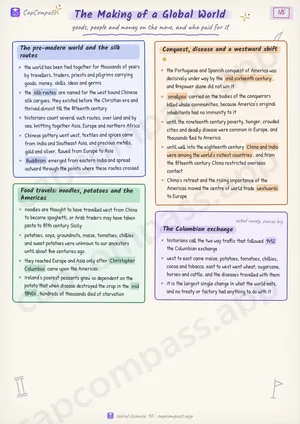
The pre-modern world and the silk routes
- the world has been tied together for thousands of years by travellers, traders, priests and pilgrims carrying goods, money, skills, ideas and germs
- the silk routes are named for the west bound Chinese silk cargoes, they existed before the Christian era and thrived almost till the fifteenth century
- historians count several such routes, over land and by sea, knitting together Asia, Europe and northern Africa
- Chinese pottery went west, textiles and spices came from India and Southeast Asia, and precious metals, gold and silver, flowed from Europe to Asia
- Buddhism emerged from eastern India and spread outward through the points where these routes crossed
Food travels: noodles, potatoes and the Americas
- noodles are thought to have travelled west from China to become spaghetti, or Arab traders may have taken pasta to fifth century Sicily
- potatoes, soya, groundnuts, maize, tomatoes, chillies and sweet potatoes were unknown to our ancestors until about five centuries ago
- they reached Europe and Asia only after Christopher Columbus came upon the Americas
- Ireland's poorest peasants grew so dependent on the potato that when disease destroyed the crop in the mid 1840s, hundreds of thousands died of starvation
Conquest, disease and a westward shift
- the Portuguese and Spanish conquest of America was decisively under way by the mid sixteenth century, and firepower alone did not win it
- smallpox carried on the bodies of the conquerors killed whole communities, because America's original inhabitants had no immunity to it
- until the nineteenth century poverty, hunger, crowded cities and deadly disease were common in Europe, and thousands fled to America
- until well into the eighteenth century China and India were among the world's richest countries, and from the fifteenth century China restricted overseas contact
- China's retreat and the rising importance of the Americas moved the centre of world trade westwards to Europe
The Columbian exchange
- historians call the two way traffic that followed 1492 the Columbian exchange
- west to east came maize, potatoes, tomatoes, chillies, cocoa and tobacco, east to west went wheat, sugarcane, horses and cattle, and the diseases travelled with them
- it is the largest single change in what the world eats, and no treaty or factory had anything to do with it
Page 1 of 5. The full sheet, all 5 pages, opens free in the app.
What this The Making of a Global World sheet covers
- The Pre-modern World
- The pre-modern world and the silk routes
- Food travels: noodles, potatoes and the Americas
- Conquest, disease and a westward shift
- The Columbian exchange
- The Nineteenth Century
- The nineteenth century, 1815 to 1914: three flows
- The Corn Laws and a world food economy
- Technology: railways, ships and refrigeration
- The Suez Canal, 1869
- Rinderpest
- Rinderpest, the cattle plague in Africa
- Indian Indentured Labour Migration
- Indian Trade, Colonialism and the Global System
- The Inter-war Economy
- The First World War as the great break
- Mass production and the boom of the 1920s
- The Great Depression
- The Great Depression, and India inside it
- Rebuilding a World Economy
- Rebuilding a world economy: Bretton Woods, 1944
- The end of that system and the turn to globalisation
- The World Trade Organisation, 1995
- Traps that cost marks
- Tricks that make it stick
How CapCompass uses this sheet
These notes are not a standalone PDF. CapCompass plans Social Science chapter by chapter against your real exam dates and free hours, and when the plan reaches The Making of a Global World the sheet opens inside the study block itself — at the page covering the sub-topic that block is on, with the timer still running. Revision arrives at the moment the plan says revise, instead of having to be gone looking for.