Plant Kingdom — Class 11 ISC Biology revision notes
A 5-page visual revision sheet for Plant Kingdom, written for Class 11 ISC Biology. Formulas, diagrams and the traps that cost marks, laid out to be read the night before rather than the term before. Free, and it opens inside CapCompass.
 Page 1 as PDF
Plant Kingdom in one look
algae to angiosperms, and the life cycle that keeps changing
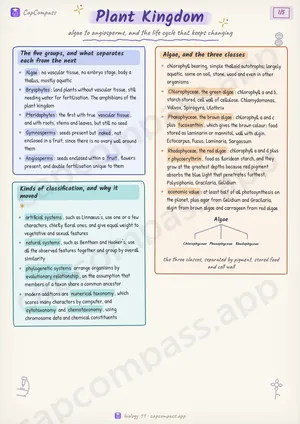
The five groups, and what separates each from the next
- Algae: no vascular tissue, no embryo stage, body a thallus, mostly aquatic
- Bryophytes: land plants without vascular tissue, still needing water for fertilisation. The amphibians of the plant kingdom
- Pteridophytes: the first with true vascular tissue, and with roots, stems and leaves, but still no seed
- Gymnosperms: seeds present but naked, not enclosed in a fruit, since there is no ovary wall around them
- Angiosperms: seeds enclosed within a fruit, flowers present, and double fertilisation unique to them
Kinds of classification, and why it moved
- artificial systems, such as Linnaeus's, use one or a few characters, chiefly floral ones, and give equal weight to vegetative and sexual features
- natural systems, such as Bentham and Hooker's, use all the observed features together and group by overall similarity
- phylogenetic systems arrange organisms by evolutionary relationship, on the assumption that members of a taxon share a common ancestor
- modern additions are numerical taxonomy, which scores many characters by computer, and cytotaxonomy and chemotaxonomy, using chromosome data and chemical constituents
Algae, and the three classes
- chlorophyll bearing, simple thalloid autotrophs; largely aquatic, some on soil, stone, wood and even in other organisms
- Chlorophyceae, the green algae: chlorophyll a and b, starch stored, cell wall of cellulose. Chlamydomonas, Volvox, Spirogyra, Ulothrix
- Phaeophyceae, the brown algae: chlorophyll a and c plus fucoxanthin, which gives the brown colour; food stored as laminarin or mannitol, wall with algin. Ectocarpus, Fucus, Laminaria, Sargassum
- Rhodophyceae, the red algae: chlorophyll a and d plus r phycoerythrin, food as floridean starch, and they grow at the greatest depths because red pigment absorbs the blue light that penetrates furthest. Polysiphonia, Gracilaria, Gelidium
- economic value: at least half of all photosynthesis on the planet, plus agar from Gelidium and Gracilaria, algin from brown algae and carrageen from red algae
Page 1 of 5. The full sheet, all 5 pages, opens free in the app.
What this Plant Kingdom sheet covers
- The five groups, and what separates each from the next
- Kinds of classification, and why it moved
- Algae, and the three classes
- Bryophytes, and where they fall short of land
- Pteridophytes, the first vascular plants
- Gymnosperms
- Angiosperms, and their two classes
- The five groups, on the characters that are asked
- Alternation of generations, said precisely
- The economic products worth naming
- Names to keep the right way round
- The heterospory story, told in one line
- Why red algae grow deepest
- Traps that cost marks
- Tricks that save time
How CapCompass uses this sheet
These notes are not a standalone PDF. CapCompass plans Biology chapter by chapter against your real exam dates and free hours, and when the plan reaches Plant Kingdom the sheet opens inside the study block itself — at the page covering the sub-topic that block is on, with the timer still running. Revision arrives at the moment the plan says revise, instead of having to be gone looking for.