The Living World — Class 11 ISC Biology revision notes
A 4-page visual revision sheet for The Living World, written for Class 11 ISC Biology. Formulas, diagrams and the traps that cost marks, laid out to be read the night before rather than the term before. Free, and it opens inside CapCompass.
 Page 1 as PDF
The Living World in one look
what counts as alive, and how it gets a name
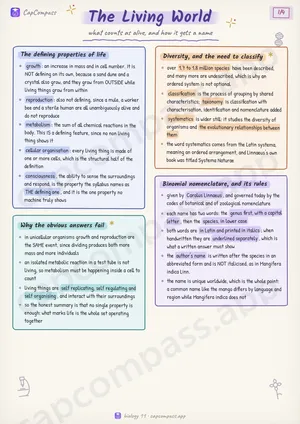
The defining properties of life
- growth: an increase in mass and in cell number. It is NOT defining on its own, because a sand dune and a crystal also grow, and they grow from OUTSIDE while living things grow from within
- reproduction: also not defining, since a mule, a worker bee and a sterile human are all unambiguously alive and do not reproduce
- metabolism: the sum of all chemical reactions in the body. This IS a defining feature, since no non living thing shows it
- cellular organisation: every living thing is made of one or more cells, which is the structural half of the definition
- consciousness, the ability to sense the surroundings and respond, is the property the syllabus names as THE defining one, and it is the one property no machine truly shows
Why the obvious answers fail
- in unicellular organisms growth and reproduction are the SAME event, since dividing produces both more mass and more individuals
- an isolated metabolic reaction in a test tube is not living, so metabolism must be happening inside a cell to count
- living things are self replicating, self regulating and self organising, and interact with their surroundings
- so the honest summary is that no single property is enough: what marks life is the whole set operating together
Diversity, and the need to classify
- over 1.7 to 1.8 million species have been described, and many more are undescribed, which is why an ordered system is not optional
- classification is the process of grouping by shared characteristics; taxonomy is classification with characterisation, identification and nomenclature added
- systematics is wider still: it studies the diversity of organisms and the evolutionary relationships between them
- the word systematics comes from the Latin systema, meaning an ordered arrangement, and Linnaeus's own book was titled Systema Naturae
Binomial nomenclature, and its rules
- given by Carolus Linnaeus, and governed today by the codes of botanical and of zoological nomenclature
- each name has two words: the genus first, with a capital letter, then the species, in lower case
- both words are in Latin and printed in italics; when handwritten they are underlined separately, which is what a written answer must show
- the author's name is written after the species in an abbreviated form and is NOT italicised, as in Mangifera indica Linn.
- the name is unique worldwide, which is the whole point: a common name like the mango differs by language and region while Mangifera indica does not
Page 1 of 4. The full sheet, all 4 pages, opens free in the app.
What this The Living World sheet covers
- The defining properties of life
- Why the obvious answers fail
- Diversity, and the need to classify
- Binomial nomenclature, and its rules
- The taxonomic hierarchy, top to bottom
- Species, the unit that is harder than it looks
- The taxonomic aids, and what each is for
- Keys, used properly
- The three domain idea, in outline
- The examples worth carrying in
- Making a herbarium sheet, in order
- The words that are constantly confused
- Why the herbarium label is a legal document
- Traps that cost marks
- Tricks that save time
How CapCompass uses this sheet
These notes are not a standalone PDF. CapCompass plans Biology chapter by chapter against your real exam dates and free hours, and when the plan reaches The Living World the sheet opens inside the study block itself — at the page covering the sub-topic that block is on, with the timer still running. Revision arrives at the moment the plan says revise, instead of having to be gone looking for.