Chemical Kinetics — Class 12 ISC Chemistry revision notes
A 4-page visual revision sheet for Chemical Kinetics, written for Class 12 ISC Chemistry. Formulas, diagrams and the traps that cost marks, laid out to be read the night before rather than the term before. Free, and it opens inside CapCompass.
 Page 1 as PDF
Chemical Kinetics in one look
how fast, in what order, and over what barrier
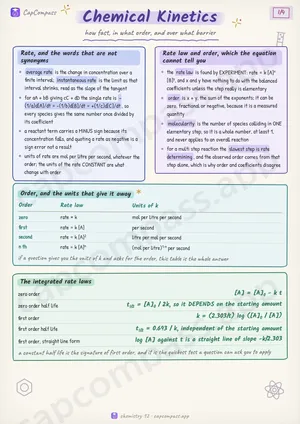
Rate, and the words that are not synonyms
- average rate is the change in concentration over a finite interval; instantaneous rate is the limit as that interval shrinks, read as the slope of the tangent
- for aA + bB giving cC + dD the single rate is -(1/a)d[A]/dt = -(1/b)d[B]/dt = +(1/c)d[C]/dt, so every species gives the same number once divided by its coefficient
- a reactant term carries a MINUS sign because its concentration falls, and quoting a rate as negative is a sign error not a result
- units of rate are mol per litre per second, whatever the order; the units of the rate CONSTANT are what change with order
Rate law and order, which the equation cannot tell you
- the rate law is found by EXPERIMENT: rate = k [A]^x [B]^y, and x and y have nothing to do with the balanced coefficients unless the step really is elementary
- order is x + y, the sum of the exponents; it can be zero, fractional or negative, because it is a measured quantity
- molecularity is the number of species colliding in ONE elementary step, so it is a whole number, at least 1, and never applies to an overall reaction
- for a multi step reaction the slowest step is rate determining, and the observed order comes from that step alone, which is why order and coefficients disagree
Order, and the units that give it away
| Order | Rate law | Units of k |
|---|---|---|
| zero | rate = k | mol per litre per second |
| first | rate = k [A] | per second |
| second | rate = k [A]^2 | litre per mol per second |
| n th | rate = k [A]^n | (mol per litre)^1-n per second |
The integrated rate laws
- zero order
[A] = [A]_0 - k t - zero order half life
t_1/2 = [A]_0 / 2k, so it DEPENDS on the starting amount - first order
k = (2.303/t) log ([A]_0 / [A]) - first order half life
t_1/2 = 0.693 / k, independent of the starting amount - first order, straight line form
log [A] against t is a straight line of slope -k/2.303
Page 1 of 4. The full sheet, all 4 pages, opens free in the app.
What this Chemical Kinetics sheet covers
- Rate, and the words that are not synonyms
- Rate law and order, which the equation cannot tell you
- Order, and the units that give it away
- The integrated rate laws
- zero order
- zero order half life
- first order
- first order half life
- first order, straight line form
- Recognising the order from data
- Zero order, which is rarer than it sounds
- What decides the rate in the first place
- Collision theory, and the two conditions
- The energy profile, read left to right
- Arrhenius, in the three forms it is asked in
- the equation
- logarithmic form
- graph
- two temperatures
- temperature coefficient
- Reading the Arrhenius equation
- Catalysis, in one box
- First order kinetics without a concentration
- Traps that cost marks
- Tricks that save time
How CapCompass uses this sheet
These notes are not a standalone PDF. CapCompass plans Chemistry chapter by chapter against your real exam dates and free hours, and when the plan reaches Chemical Kinetics the sheet opens inside the study block itself — at the page covering the sub-topic that block is on, with the timer still running. Revision arrives at the moment the plan says revise, instead of having to be gone looking for.