Solutions — Class 12 ISC Chemistry revision notes
A 5-page visual revision sheet for Solutions, written for Class 12 ISC Chemistry. Formulas, diagrams and the traps that cost marks, laid out to be read the night before rather than the term before. Free, and it opens inside CapCompass.
 Page 1 as PDF
Solutions in one look
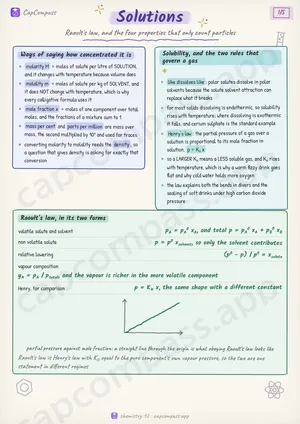
Raoult's law, and the four properties that only count particles
Ways of saying how concentrated it is
- molarity M = moles of solute per litre of SOLUTION, and it changes with temperature because volume does
- molality m = moles of solute per kg of SOLVENT, and it does NOT change with temperature, which is why every colligative formula uses it
- mole fraction x = moles of one component over total moles, and the fractions of a mixture sum to 1
- mass per cent and parts per million are mass over mass, the second multiplied by 10^6 and used for traces
- converting molarity to molality needs the density, so a question that gives density is asking for exactly that conversion
Solubility, and the two rules that govern a gas
- like dissolves like: polar solutes dissolve in polar solvents because the solute solvent attraction can replace what it breaks
- for most solids dissolving is endothermic, so solubility rises with temperature; where dissolving is exothermic it falls, and cerium sulphate is the standard example
- Henry's law: the partial pressure of a gas over a solution is proportional to its mole fraction in solution, p = K_H x
- so a LARGER K_H means a LESS soluble gas, and K_H rises with temperature, which is why a warm fizzy drink goes flat and why cold water holds more oxygen
- the law explains both the bends in divers and the sealing of soft drinks under high carbon dioxide pressure
Raoult's law, in its two forms
- volatile solute and solvent
p_A = p_A^0 x_A, and total p = p_A^0 x_A + p_B^0 x_B - non volatile solute
p = p^0 x_solvent, so only the solvent contributes - relative lowering
(p^0 - p) / p^0 = x_solute - vapour composition
y_A = p_A / p_total, and the vapour is richer in the more volatile component - Henry, for comparison
p = K_H x, the same shape with a different constant
Page 1 of 5. The full sheet, all 5 pages, opens free in the app.
What this Solutions sheet covers
- types and concentration
- types of solutions
- Ways of saying how concentrated it is
- Solubility, and the two rules that govern a gas
- Raoult's law, in its two forms
- volatile solute and solvent
- non volatile solute
- relative lowering
- vapour composition
- Henry, for comparison
- Ideal and non ideal solutions
- Azeotropes, which is where distillation stops working
- The four colligative properties
- The four, with the molar mass each one gives
- boiling point elevation
- freezing point depression
- osmotic pressure
- from osmotic pressure
- Molar mass from freezing point depression
- Which property to use, and why
- van't hoff factor
- Abnormal molar mass, and the factor that fixes it
- Putting the factor into all four
- vapour pressure
- boiling point
- freezing point
- degree of dissociation
- degree of association
- Working an abnormal molar mass question
- Why the elevation and depression happen at all
- The numbers worth carrying in
- Traps that cost marks
- Tricks that save time
How CapCompass uses this sheet
These notes are not a standalone PDF. CapCompass plans Chemistry chapter by chapter against your real exam dates and free hours, and when the plan reaches Solutions the sheet opens inside the study block itself — at the page covering the sub-topic that block is on, with the timer still running. Revision arrives at the moment the plan says revise, instead of having to be gone looking for.