Electrochemistry — Class 12 ISC Chemistry revision notes
A 5-page visual revision sheet for Electrochemistry, written for Class 12 ISC Chemistry. Formulas, diagrams and the traps that cost marks, laid out to be read the night before rather than the term before. Free, and it opens inside CapCompass.
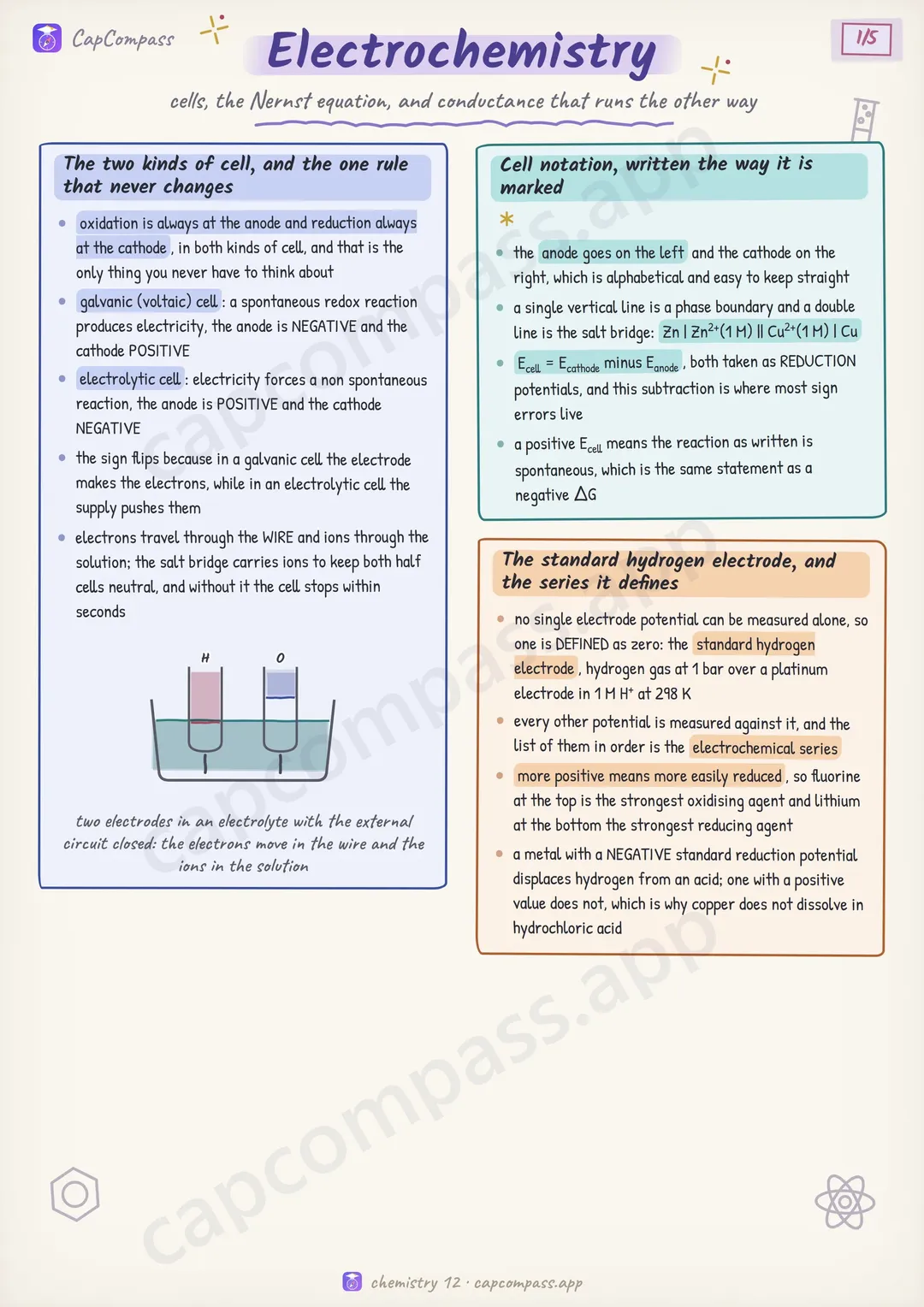 Page 1 as PDF
Electrochemistry in one look
cells, the Nernst equation, and conductance that runs the other way
The two kinds of cell, and the one rule that never changes
- oxidation is always at the anode and reduction always at the cathode, in both kinds of cell, and that is the only thing you never have to think about
- galvanic (voltaic) cell: a spontaneous redox reaction produces electricity, the anode is NEGATIVE and the cathode POSITIVE
- electrolytic cell: electricity forces a non spontaneous reaction, the anode is POSITIVE and the cathode NEGATIVE
- the sign flips because in a galvanic cell the electrode makes the electrons, while in an electrolytic cell the supply pushes them
- electrons travel through the WIRE and ions through the solution; the salt bridge carries ions to keep both half cells neutral, and without it the cell stops within seconds
Cell notation, written the way it is marked
- the anode goes on the left and the cathode on the right, which is alphabetical and easy to keep straight
- a single vertical line is a phase boundary and a double line is the salt bridge: Zn | Zn^2+(1 M) || Cu^2+(1 M) | Cu
- E_cell = E_cathode minus E_anode, both taken as REDUCTION potentials, and this subtraction is where most sign errors live
- a positive E_cell means the reaction as written is spontaneous, which is the same statement as a negative ΔG
The standard hydrogen electrode, and the series it defines
- no single electrode potential can be measured alone, so one is DEFINED as zero: the standard hydrogen electrode, hydrogen gas at 1 bar over a platinum electrode in 1 M H^+ at 298 K
- every other potential is measured against it, and the list of them in order is the electrochemical series
- more positive means more easily reduced, so fluorine at the top is the strongest oxidising agent and lithium at the bottom the strongest reducing agent
- a metal with a NEGATIVE standard reduction potential displaces hydrogen from an acid; one with a positive value does not, which is why copper does not dissolve in hydrochloric acid
Page 1 of 5. The full sheet, all 5 pages, opens free in the app.
What this Electrochemistry sheet covers
- The two kinds of cell, and the one rule that never changes
- Cell notation, written the way it is marked
- The standard hydrogen electrode, and the series it defines
- The Nernst equation and what hangs off it
- for a general cell
- at equilibrium
- free energy
- the Faraday constant
- for a single electrode
- Reading the Nernst equation without slips
- The three signs, kept in step (standard conditions)
- Conductance, and why it needs its own vocabulary
- Strong against weak, seen in the conductivity
- The conductance formulas
- conductivity
- molar conductivity
- Kohlrausch
- degree of dissociation
- dissociation constant
- faraday's laws
- Electrolysis, and the products you actually get
- Batteries and corrosion
- Overvoltage, the reason the predictions sometimes fail
- The numbers and standard potentials worth carrying in
- Traps that cost marks
- Tricks that save time
How CapCompass uses this sheet
These notes are not a standalone PDF. CapCompass plans Chemistry chapter by chapter against your real exam dates and free hours, and when the plan reaches Electrochemistry the sheet opens inside the study block itself — at the page covering the sub-topic that block is on, with the timer still running. Revision arrives at the moment the plan says revise, instead of having to be gone looking for.