Classification of Elements and Periodicity in Properties — Class 11 ISC Chemistry revision notes
A 4-page visual revision sheet for Classification of Elements and Periodicity in Properties, written for Class 11 ISC Chemistry. Formulas, diagrams and the traps that cost marks, laid out to be read the night before rather than the term before. Free, and it opens inside CapCompass.
 Page 1 as PDF
Classification of Elements and Periodicity in Properties in one look
one table, and the four trends that explain the rest of chemistry
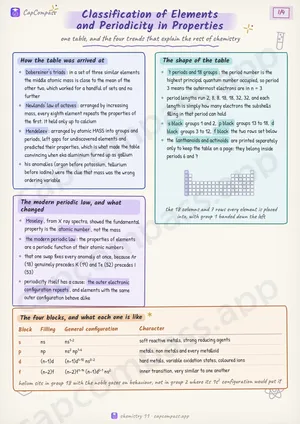
How the table was arrived at
- Dobereiner's triads: in a set of three similar elements the middle atomic mass is close to the mean of the other two, which worked for a handful of sets and no further
- Newlands' law of octaves: arranged by increasing mass, every eighth element repeats the properties of the first. It held only up to calcium
- Mendeleev: arranged by atomic MASS into groups and periods, left gaps for undiscovered elements and predicted their properties, which is what made the table convincing when eka aluminium turned up as gallium
- his anomalies (argon before potassium, tellurium before iodine) were the clue that mass was the wrong ordering variable
The modern periodic law, and what changed
- Moseley, from X ray spectra, showed the fundamental property is the atomic number, not the mass
- the modern periodic law: the properties of elements are a periodic function of their atomic numbers
- that one swap fixes every anomaly at once, because Ar (18) genuinely precedes K (19) and Te (52) precedes I (53)
- periodicity itself has a cause: the outer electronic configuration repeats, and elements with the same outer configuration behave alike
The shape of the table
- 7 periods and 18 groups; the period number is the highest principal quantum number occupied, so period 3 means the outermost electrons are in n = 3
- period lengths run 2, 8, 8, 18, 18, 32, 32, and each length is simply how many electrons the subshells filling in that period can hold
- s block groups 1 and 2, p block groups 13 to 18, d block groups 3 to 12, f block the two rows set below
- the lanthanoids and actinoids are printed separately only to keep the table on a page: they belong inside periods 6 and 7
The four blocks, and what each one is like
| Block | Filling | General configuration | Character |
|---|---|---|---|
| s | ns | ns^1-2 | soft reactive metals, strong reducing agents |
| p | np | ns^2 np^1-6 | metals, non metals and every metalloid |
| d | (n-1)d | (n-1)d^1-10 ns^0-2 | hard metals, variable oxidation states, coloured ions |
| f | (n-2)f | (n-2)f^1-14 (n-1)d^0-1 ns^2 | inner transition, very similar to one another |
Page 1 of 4. The full sheet, all 4 pages, opens free in the app.
What this Classification of Elements and Periodicity in Properties sheet covers
- How the table was arrived at
- The modern periodic law, and what changed
- The shape of the table
- The four blocks, and what each one is like
- Placing an element from its configuration alone
- Two words that drive everything after this
- Atomic and ionic size
- Ionisation enthalpy, and its two famous dips
- Electron gain enthalpy and electronegativity
- The four trends on one page
- Valence, oxidation state and the character of the oxides
- The anomalous first members
- Naming the elements beyond 100
- Traps that cost marks
- Tricks that save time
How CapCompass uses this sheet
These notes are not a standalone PDF. CapCompass plans Chemistry chapter by chapter against your real exam dates and free hours, and when the plan reaches Classification of Elements and Periodicity in Properties the sheet opens inside the study block itself — at the page covering the sub-topic that block is on, with the timer still running. Revision arrives at the moment the plan says revise, instead of having to be gone looking for.