Some Basic Concepts of Chemistry — Class 11 ISC Chemistry revision notes
A 5-page visual revision sheet for Some Basic Concepts of Chemistry, written for Class 11 ISC Chemistry. Formulas, diagrams and the traps that cost marks, laid out to be read the night before rather than the term before. Free, and it opens inside CapCompass.
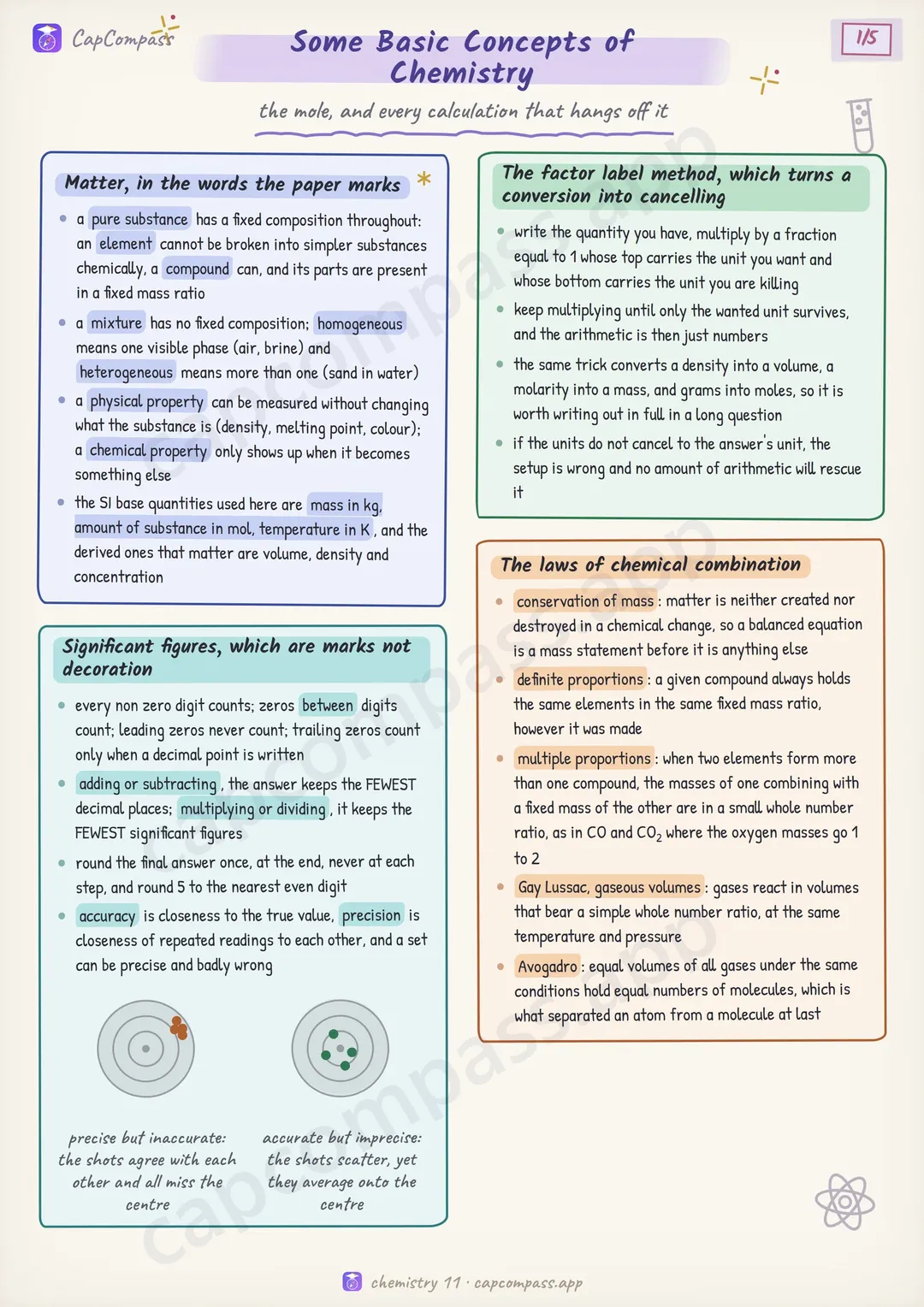 Page 1 as PDF
Some Basic Concepts of Chemistry in one look
the mole, and every calculation that hangs off it
Matter, in the words the paper marks
- a pure substance has a fixed composition throughout: an element cannot be broken into simpler substances chemically, a compound can, and its parts are present in a fixed mass ratio
- a mixture has no fixed composition; homogeneous means one visible phase (air, brine) and heterogeneous means more than one (sand in water)
- a physical property can be measured without changing what the substance is (density, melting point, colour); a chemical property only shows up when it becomes something else
- the SI base quantities used here are mass in kg, amount of substance in mol, temperature in K, and the derived ones that matter are volume, density and concentration
Significant figures, which are marks not decoration
- every non zero digit counts; zeros between digits count; leading zeros never count; trailing zeros count only when a decimal point is written
- adding or subtracting, the answer keeps the FEWEST decimal places; multiplying or dividing, it keeps the FEWEST significant figures
- round the final answer once, at the end, never at each step, and round 5 to the nearest even digit
- accuracy is closeness to the true value, precision is closeness of repeated readings to each other, and a set can be precise and badly wrong
The factor label method, which turns a conversion into cancelling
- write the quantity you have, multiply by a fraction equal to 1 whose top carries the unit you want and whose bottom carries the unit you are killing
- keep multiplying until only the wanted unit survives, and the arithmetic is then just numbers
- the same trick converts a density into a volume, a molarity into a mass, and grams into moles, so it is worth writing out in full in a long question
- if the units do not cancel to the answer's unit, the setup is wrong and no amount of arithmetic will rescue it
The laws of chemical combination
- conservation of mass: matter is neither created nor destroyed in a chemical change, so a balanced equation is a mass statement before it is anything else
- definite proportions: a given compound always holds the same elements in the same fixed mass ratio, however it was made
- multiple proportions: when two elements form more than one compound, the masses of one combining with a fixed mass of the other are in a small whole number ratio, as in CO and CO_2 where the oxygen masses go 1 to 2
- Gay Lussac, gaseous volumes: gases react in volumes that bear a simple whole number ratio, at the same temperature and pressure
- Avogadro: equal volumes of all gases under the same conditions hold equal numbers of molecules, which is what separated an atom from a molecule at last
Page 1 of 5. The full sheet, all 5 pages, opens free in the app.
What this Some Basic Concepts of Chemistry sheet covers
- Matter, in the words the paper marks
- Significant figures, which are marks not decoration
- The factor label method, which turns a conversion into cancelling
- The laws of chemical combination
- Dalton's theory, and the three parts of it that are now known to be wrong
- Masses, and which word goes with which particle
- mole concept
- molar mass
- The mole: four doors into the same number
- from mass
- from particles
- from gas volume at STP
- from a solution
- the definition itself
- What a mole is, and what it is not
- Percentage composition, and the two formulas
- Stoichiometry, read off a balanced equation
- Concentration, five ways of saying how much is dissolved
- molarity M
- molality m
- mole fraction x
- mass per cent
- parts per million
- on dilution
- Percentage yield, and why it is never 100
- Equivalent mass and normality, the older bookkeeping
- Traps that cost marks
- Tricks that save time
How CapCompass uses this sheet
These notes are not a standalone PDF. CapCompass plans Chemistry chapter by chapter against your real exam dates and free hours, and when the plan reaches Some Basic Concepts of Chemistry the sheet opens inside the study block itself — at the page covering the sub-topic that block is on, with the timer still running. Revision arrives at the moment the plan says revise, instead of having to be gone looking for.