Structure of Atom — Class 11 ISC Chemistry revision notes
A 5-page visual revision sheet for Structure of Atom, written for Class 11 ISC Chemistry. Formulas, diagrams and the traps that cost marks, laid out to be read the night before rather than the term before. Free, and it opens inside CapCompass.
 Page 1 as PDF
Structure of Atom in one look
from a plum pudding to four quantum numbers
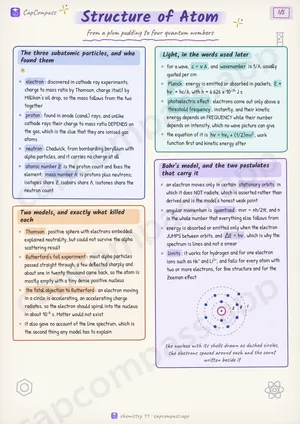
The three subatomic particles, and who found them
- electron: discovered in cathode ray experiments, charge to mass ratio by Thomson, charge itself by Millikan's oil drop, so the mass follows from the two together
- proton: found in anode (canal) rays, and unlike cathode rays their charge to mass ratio DEPENDS on the gas, which is the clue that they are ionised gas atoms
- neutron: Chadwick, from bombarding beryllium with alpha particles, and it carries no charge at all
- atomic number Z is the proton count and fixes the element; mass number A is protons plus neutrons; isotopes share Z, isobars share A, isotones share the neutron count
Two models, and exactly what killed each
- Thomson, positive sphere with electrons embedded: explained neutrality, but could not survive the alpha scattering result
- Rutherford's foil experiment: most alpha particles passed straight through, a few deflected sharply and about one in twenty thousand came back, so the atom is mostly empty with a tiny dense positive nucleus
- the fatal objection to Rutherford: an electron moving in a circle is accelerating, an accelerating charge radiates, so the electron should spiral into the nucleus in about 10^-8 s. Matter would not exist
- it also gave no account of the line spectrum, which is the second thing any model has to explain
Light, in the words used later
- for a wave, c = ν λ, and wavenumber is 1/λ, usually quoted per cm
- Planck: energy is emitted or absorbed in packets, E = hν = hc/λ, with h = 6.626 x 10^-34 J s
- photoelectric effect: electrons come out only above a threshold frequency, instantly, and their kinetic energy depends on FREQUENCY while their number depends on intensity, which no wave picture can give
- the equation of it is hν = hν_0 + (1/2)mv^2, work function first and kinetic energy after
Bohr's model, and the two postulates that carry it
- an electron moves only in certain stationary orbits in which it does NOT radiate, which is asserted rather than derived and is the model's honest weak point
- angular momentum is quantised: mvr = nh/2π, and n is the whole number that everything else follows from
- energy is absorbed or emitted only when the electron JUMPS between orbits, and ΔE = hν, which is why the spectrum is lines and not a smear
- limits: it works for hydrogen and for one electron ions such as He^+ and Li^2+, and fails for every atom with two or more electrons, for fine structure and for the Zeeman effect
Page 1 of 5. The full sheet, all 5 pages, opens free in the app.
What this Structure of Atom sheet covers
- The three subatomic particles, and who found them
- Two models, and exactly what killed each
- Light, in the words used later
- Bohr's model, and the two postulates that carry it
- The hydrogen numbers worth knowing by heart
- radius of the nth orbit
- energy of the nth orbit
- velocity in the nth orbit
- spectral lines, Rydberg
- ionisation energy of hydrogen
- The hydrogen series, and where each one lands
- Why the model had to be replaced
- The quantum mechanical model in four numbers
- Capacity, subshell by subshell
- Filling the orbitals, three rules in order
- Writing a configuration without slips
- Photoelectric arithmetic, and the stopping potential
- Isoelectronic species, and the size order inside a set
- Traps that cost marks
- Tricks that save time
How CapCompass uses this sheet
These notes are not a standalone PDF. CapCompass plans Chemistry chapter by chapter against your real exam dates and free hours, and when the plan reaches Structure of Atom the sheet opens inside the study block itself — at the page covering the sub-topic that block is on, with the timer still running. Revision arrives at the moment the plan says revise, instead of having to be gone looking for.