Electrostatic Potential and Capacitance — Class 12 ISC Physics revision notes
A 5-page visual revision sheet for Electrostatic Potential and Capacitance, written for Class 12 ISC Physics. Formulas, diagrams and the traps that cost marks, laid out to be read the night before rather than the term before. Free, and it opens inside CapCompass.
 Page 1 as PDF
Electrostatic Potential and Capacitance in one look
energy per charge, and the device that stores it
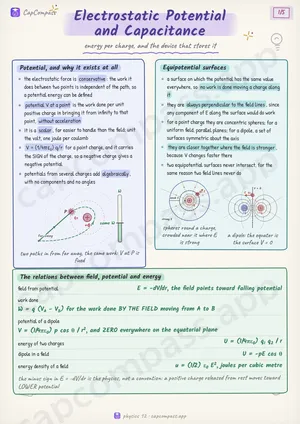
Potential, and why it exists at all
- the electrostatic force is conservative: the work it does between two points is independent of the path, so a potential energy can be defined
- potential V at a point is the work done per unit positive charge in bringing it from infinity to that point, without acceleration
- it is a scalar, far easier to handle than the field; unit the volt, one joule per coulomb
- V = (1/4πε_0) q/r for a point charge, and it carries the SIGN of the charge, so a negative charge gives a negative potential
- potentials from several charges add algebraically, with no components and no angles
Equipotential surfaces
- a surface on which the potential has the same value everywhere, so no work is done moving a charge along it
- they are always perpendicular to the field lines, since any component of E along the surface would do work
- for a point charge they are concentric spheres; for a uniform field, parallel planes; for a dipole, a set of surfaces symmetric about the axis
- they are closer together where the field is stronger, because V changes faster there
- two equipotential surfaces never intersect, for the same reason two field lines never do
The relations between field, potential and energy
- field from potential
E = -dV/dr, the field points toward falling potential - work done
W = q (V_A - V_B) for the work done BY THE FIELD moving from A to B - potential of a dipole
V = (1/4πε_0) p cos θ / r^2, and ZERO everywhere on the equatorial plane - energy of two charges
U = (1/4πε_0) q_1 q_2 / r - dipole in a field
U = -pE cos θ - energy density of a field
u = (1/2) ε_0 E^2, joules per cubic metre
Page 1 of 5. The full sheet, all 5 pages, opens free in the app.
What this Electrostatic Potential and Capacitance sheet covers
- Potential, and why it exists at all
- Equipotential surfaces
- The relations between field, potential and energy
- field from potential
- work done
- potential of a dipole
- energy of two charges
- dipole in a field
- energy density of a field
- Potential due to standard bodies
- Potential energy of a system
- Conductors, restated in terms of potential
- Capacitance
- Combinations, and the energy stored
- in series
- in parallel
- energy stored
- with a dielectric slab
- with a conducting slab
- spherical capacitor
- The two questions to ask before any dielectric problem
- Where the energy of a capacitor actually is
- Van de Graaff generator
- dielectrics and polarisation
- polarisation
- The dielectric, quantitatively
- Self energy of a shell and of a solid sphere
- Traps that cost marks
- Tricks that save time
How CapCompass uses this sheet
These notes are not a standalone PDF. CapCompass plans Physics chapter by chapter against your real exam dates and free hours, and when the plan reaches Electrostatic Potential and Capacitance the sheet opens inside the study block itself — at the page covering the sub-topic that block is on, with the timer still running. Revision arrives at the moment the plan says revise, instead of having to be gone looking for.