Matrices — Class 12 ISC Mathematics revision notes
A 5-page visual revision sheet for Matrices, written for Class 12 ISC Mathematics. Formulas, diagrams and the traps that cost marks, laid out to be read the night before rather than the term before. Free, and it opens inside CapCompass.
 Page 1 as PDF
Matrices in one look
an algebra where order matters and division does not exist
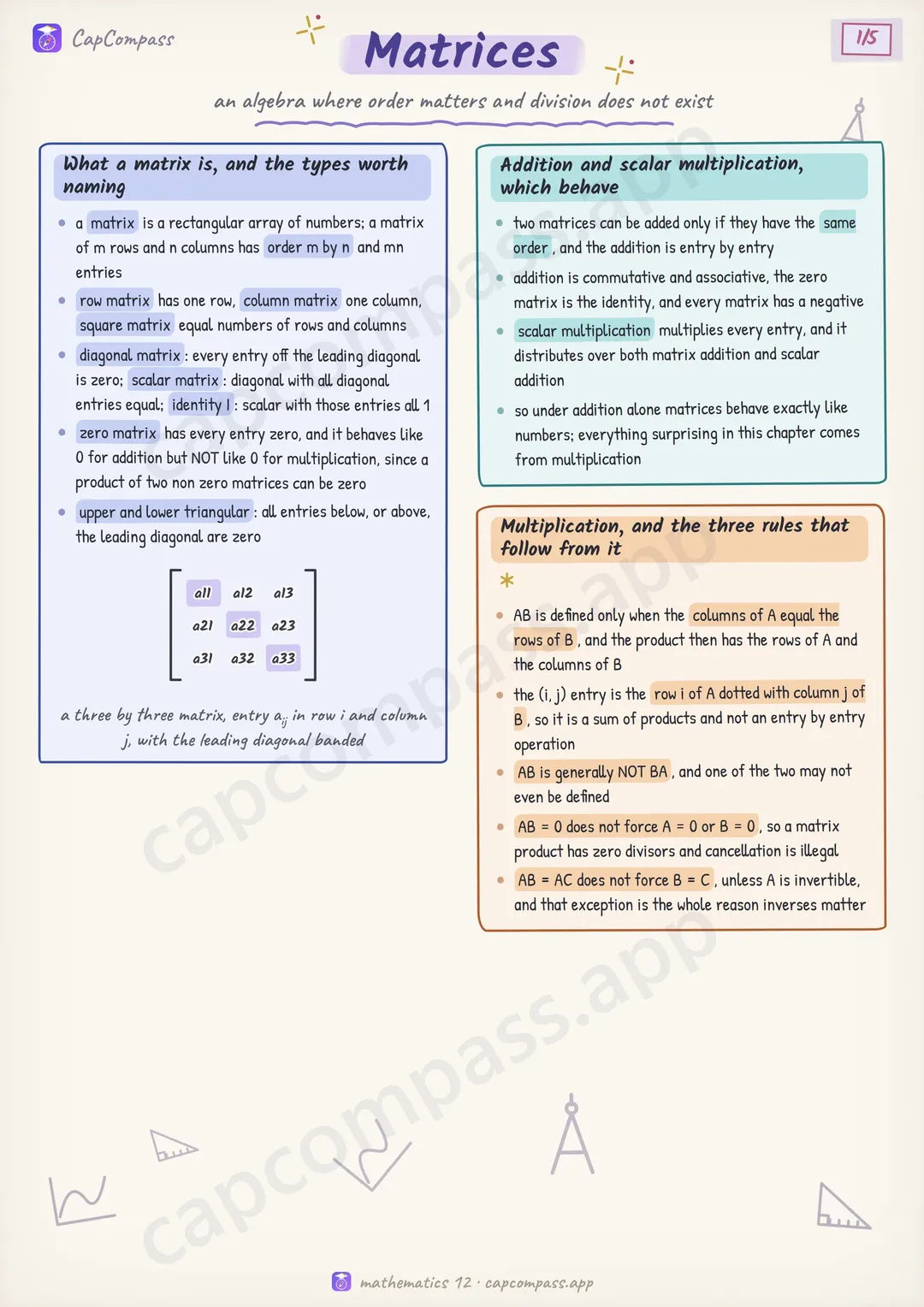
What a matrix is, and the types worth naming
- a matrix is a rectangular array of numbers; a matrix of m rows and n columns has order m by n and mn entries
- row matrix has one row, column matrix one column, square matrix equal numbers of rows and columns
- diagonal matrix: every entry off the leading diagonal is zero; scalar matrix: diagonal with all diagonal entries equal; identity I: scalar with those entries all 1
- zero matrix has every entry zero, and it behaves like 0 for addition but NOT like 0 for multiplication, since a product of two non zero matrices can be zero
- upper and lower triangular: all entries below, or above, the leading diagonal are zero
Addition and scalar multiplication, which behave
- two matrices can be added only if they have the same order, and the addition is entry by entry
- addition is commutative and associative, the zero matrix is the identity, and every matrix has a negative
- scalar multiplication multiplies every entry, and it distributes over both matrix addition and scalar addition
- so under addition alone matrices behave exactly like numbers; everything surprising in this chapter comes from multiplication
Multiplication, and the three rules that follow from it
- AB is defined only when the columns of A equal the rows of B, and the product then has the rows of A and the columns of B
- the (i, j) entry is the row i of A dotted with column j of B, so it is a sum of products and not an entry by entry operation
- AB is generally NOT BA, and one of the two may not even be defined
- AB = 0 does not force A = 0 or B = 0, so a matrix product has zero divisors and cancellation is illegal
- AB = AC does not force B = C, unless A is invertible, and that exception is the whole reason inverses matter
Page 1 of 5. The full sheet, all 5 pages, opens free in the app.
What this Matrices sheet covers
- types of matrices
- What a matrix is, and the types worth naming
- Addition and scalar multiplication, which behave
- operations on matrices
- Multiplication, and the three rules that follow from it
- Transpose and the algebra it obeys
- definition
- double transpose
- sum
- scalar
- product, order reversed
- inverse
- Symmetric and skew symmetric
- Elementary row operations
- Determinant, adjoint and inverse
- two by two determinant
- cofactor
- adjoint
- the key identity
- determinant of a product
- Singular, non singular, and what follows
- Solving a system with matrices
- Powers of a matrix
- Working a proof question
- The two by two facts that shorten everything
- The matrix that is its own inverse
- Traps that cost marks
- Tricks that save time
How CapCompass uses this sheet
These notes are not a standalone PDF. CapCompass plans Mathematics chapter by chapter against your real exam dates and free hours, and when the plan reaches Matrices the sheet opens inside the study block itself — at the page covering the sub-topic that block is on, with the timer still running. Revision arrives at the moment the plan says revise, instead of having to be gone looking for.