Relations and Functions — Class 12 ISC Mathematics revision notes
A 4-page visual revision sheet for Relations and Functions, written for Class 12 ISC Mathematics. Formulas, diagrams and the traps that cost marks, laid out to be read the night before rather than the term before. Free, and it opens inside CapCompass.
 Page 1 as PDF
Relations and Functions in one look
equivalence, one to one and onto, and the inverse that only exists sometimes
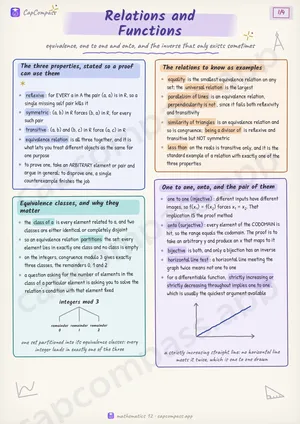
The three properties, stated so a proof can use them
- reflexive: for EVERY a in A the pair (a, a) is in R, so a single missing self pair kills it
- symmetric: (a, b) in R forces (b, a) in R, for every such pair
- transitive: (a, b) and (b, c) in R force (a, c) in R
- equivalence relation is all three together, and it is what lets you treat different objects as the same for one purpose
- to prove one, take an ARBITRARY element or pair and argue in general; to disprove one, a single counterexample finishes the job
Equivalence classes, and why they matter
- the class of a is every element related to a, and two classes are either identical or completely disjoint
- so an equivalence relation partitions the set: every element lies in exactly one class and no class is empty
- on the integers, congruence modulo 3 gives exactly three classes, the remainders 0, 1 and 2
- a question asking for the number of elements in the class of a particular element is asking you to solve the relation's condition with that element fixed
The relations to know as examples
- equality is the smallest equivalence relation on any set; the universal relation is the largest
- parallelism of lines is an equivalence relation, perpendicularity is not, since it fails both reflexivity and transitivity
- similarity of triangles is an equivalence relation and so is congruence; being a divisor of is reflexive and transitive but NOT symmetric
- less than on the reals is transitive only, and it is the standard example of a relation with exactly one of the three properties
One to one, onto, and the pair of them
- one to one (injective): different inputs have different images, so f(x_1) = f(x_2) forces x_1 = x_2. That implication IS the proof method
- onto (surjective): every element of the CODOMAIN is hit, so the range equals the codomain. The proof is to take an arbitrary y and produce an x that maps to it
- bijective is both, and only a bijection has an inverse
- horizontal line test: a horizontal line meeting the graph twice means not one to one
- for a differentiable function, strictly increasing or strictly decreasing throughout implies one to one, which is usually the quickest argument available
Page 1 of 4. The full sheet, all 4 pages, opens free in the app.
What this Relations and Functions sheet covers
- The three properties, stated so a proof can use them
- Equivalence classes, and why they matter
- The relations to know as examples
- One to one, onto, and the pair of them
- Composition and inverse
- composition
- domain condition
- inverse, defining property
- inverse, both ways
- inverse of a composition
- Finding an inverse, start to finish
- Counting, when the sets are finite
- Where a domain restriction comes from
- Binary operations
- Checking a binary operation in order
- The operation tables worth recognising
- Proving invertibility without solving for x
- Finding an inverse, and proving it exists
- Composition, without the usual slips
- Traps that cost marks
- Tricks that save time
How CapCompass uses this sheet
These notes are not a standalone PDF. CapCompass plans Mathematics chapter by chapter against your real exam dates and free hours, and when the plan reaches Relations and Functions the sheet opens inside the study block itself — at the page covering the sub-topic that block is on, with the timer still running. Revision arrives at the moment the plan says revise, instead of having to be gone looking for.