Application of Derivatives — Class 12 CBSE Mathematics revision notes
A 3-page visual revision sheet for Application of Derivatives, written for Class 12 CBSE Mathematics. Formulas, diagrams and the traps that cost marks, laid out to be read the night before rather than the term before. Free, and it opens inside CapCompass.
 Page 1 as PDF
Application of Derivatives in one look
the derivative as a rate, a slope and a turning point, three questions from one tool
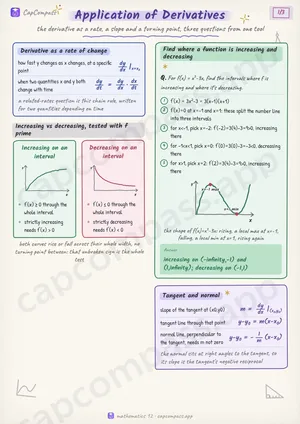
Derivative as a rate of change
- how fast y changes as x changes, at a specific point
dy/dxBig|_x=x_0 - when two quantities x and y both change with time
dy/dt = dy/dxcdotdx/dt
Increasing vs decreasing, tested with f prime
- f'(x) >= 0 through the whole interval
- strictly increasing needs f'(x) > 0
- f'(x) <= 0 through the whole interval
- strictly decreasing needs f'(x) < 0
Find where a function is increasing and decreasing
Q. For f(x) = x^3-3x, find the intervals where f is increasing and where it's decreasing.
- f'(x) = 3x^2-3 = 3(x-1)(x+1)
- f'(x)=0 at x=-1 and x=1: these split the number line into three intervals
- for x<-1, pick x=-2: f'(-2)=3(4)-3=9>0, increasing there
- for -1<x<1, pick x=0: f'(0)=3(0)-3=-3<0, decreasing there
- for x>1, pick x=2: f'(2)=3(4)-3=9>0, increasing there
Answer: increasing on (-infinity,-1) and (1,infinity); decreasing on (-1,1)
Tangent and normal
- slope of the tangent at (x0,y0)
m = dy/dxBig|_(x_0,y_0) - tangent line through that point
y-y_0 = m(x-x_0) - normal line, perpendicular to the tangent, needs m not zero
y-y_0 = -1/m(x-x_0)
Page 1 of 3. The full sheet, all 3 pages, opens free in the app.
What this Application of Derivatives sheet covers
- Derivative as a rate of change
- how fast y changes as x changes, at a specific point
- when two quantities x and y both change with time
- Increasing vs decreasing, tested with f prime
- Increasing on an interval
- Decreasing on an interval
- Find where a function is increasing and decreasing
- Tangent and normal
- slope of the tangent at (x0,y0)
- tangent line through that point
- normal line, perpendicular to the tangent, needs m not zero
- Tangent and normal to a parabola
- Special tangent cases
- Maxima and minima: first derivative test
- a critical point is x=c where f'(c)=0, or where f'(c) does not exist
- local maximum at c: f prime changes sign from positive to negative there
- local minimum at c: f prime changes sign from negative to positive there
- Classify a critical point where f prime is zero
- Second derivative test
- start from a critical point, f'(c)=0; a negative second derivative there means a local maximum
- same starting point, a positive second derivative there means a local minimum
- and a second derivative of exactly zero means the test gives no answer at all
- Types of extrema
- Local maximum
- Local minimum
- Absolute maximum
- Absolute minimum
- Find local maximum and minimum using the second derivative test
- Approximations, using the differential
- linear approximation, for a small change dx near x
- the differential itself
- Absolute extrema on a closed interval
- Reading the chapter together
- Traps that cost marks
- Tricks that save time
How CapCompass uses this sheet
These notes are not a standalone PDF. CapCompass plans Mathematics chapter by chapter against your real exam dates and free hours, and when the plan reaches Application of Derivatives the sheet opens inside the study block itself — at the page covering the sub-topic that block is on, with the timer still running. Revision arrives at the moment the plan says revise, instead of having to be gone looking for.