Binomial Distribution — Class 12 Maharashtra HSC Mathematics revision notes
A 4-page visual revision sheet for Binomial Distribution, written for Class 12 Maharashtra HSC Mathematics. Formulas, diagrams and the traps that cost marks, laid out to be read the night before rather than the term before. Free, and it opens inside CapCompass.
 Page 1 as PDF
Binomial Distribution in one look
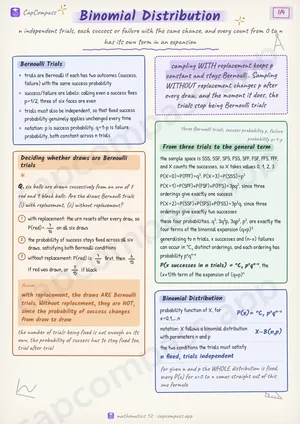
n independent trials, each success or failure with the same chance, and every count from 0 to n has its own term in an expansion
Bernoulli Trials
- trials are Bernoulli if each has two outcomes (success, failure) with the same success probability
- success/failure are labels: calling even a success fixes p=1/2, three of six faces are even
- trials must also be independent, so that fixed success probability genuinely applies unchanged every time
- notation: p is success probability, q=1-p is failure probability, both constant across n trials
Deciding whether draws are Bernoulli trials
Q. six balls are drawn successively from an urn of 7 red and 9 black balls. Are the draws Bernoulli trials (i) with replacement, (ii) without replacement?
- with replacement: the urn resets after every draw, so P(red)=7/16 on all six draws
- the probability of success stays fixed across all six draws, satisfying both Bernoulli conditions
- without replacement: P(red) is 7/16 first, then 6/15 if red was drawn, or 7/15 if black
Answer: with replacement, the draws ARE Bernoulli trials. Without replacement, they are NOT, since the probability of success changes from draw to draw
From three trials to the general term
- the sample space is SSS, SSF, SFS, FSS, SFF, FSF, FFS, FFF, and X counts the successes, so X takes values 0, 1, 2, 3
- P(X=0)=P(FFF)=q^3. P(X=3)=P(SSS)=p^3
- P(X=1)=P(SFF)+P(FSF)+P(FFS)=3pq^2, since three orderings give exactly one success
- P(X=2)=P(SSF)+P(SFS)+P(FSS)=3p^2q, since three orderings give exactly two successes
- these four probabilities, q^3, 3q^2p, 3qp^2, p^3, are exactly the four terms of the binomial expansion (q+p)^3
- generalising to n trials, x successes and (n-x) failures can occur in ^nC_x distinct orderings, and each ordering has probability p^xq^n-x
- **P(x successes in n trials) = ^nC_x p^xq^n-x**, the (x+1)th term of the expansion of (q+p)^n
Binomial Distribution
- probability function of X, for x=0,1,…,n
P(x)= ^nC_x p^xq^n-x - notation: X follows a binomial distribution with parameters n and p
Xsim B(n,p) - the two conditions the trials must satisfy
n fixed,quad trials independent
Page 1 of 4. The full sheet, all 4 pages, opens free in the app.
What this Binomial Distribution sheet covers
- Bernoulli Trials
- Deciding whether draws are Bernoulli trials
- From three trials to the general term
- Binomial Distribution
- probability function of X, for x=0,1,…,n
- notation: X follows a binomial distribution with parameters n and p
- the two conditions the trials must satisfy
- Exact, at least, and at most, from one coin experiment
- At least one success, from the complement
- Mean and Variance of Binomial Distribution
- mean, or expected value, of Xsim B(n,p)
- variance of X
- standard deviation
- Mean and variance from n and p directly
- Recovering n and p from the mean and variance
- Three shapes worth recognising
- With Replacement vs Without Replacement
- With replacement
- Without replacement
- Symbols
- Traps that cost marks
- Tricks that save time
How CapCompass uses this sheet
These notes are not a standalone PDF. CapCompass plans Mathematics chapter by chapter against your real exam dates and free hours, and when the plan reaches Binomial Distribution the sheet opens inside the study block itself — at the page covering the sub-topic that block is on, with the timer still running. Revision arrives at the moment the plan says revise, instead of having to be gone looking for.