Implementation of Algorithms — Class 12 ISC Computer Science revision notes
A 3-page visual revision sheet for Implementation of Algorithms, written for Class 12 ISC Computer Science. Formulas, diagrams and the traps that cost marks, laid out to be read the night before rather than the term before. Free, and it opens inside CapCompass.
 Page 1 as PDF
Implementation of Algorithms in one look
tracing insertion sort and binary search, step by step, by hand
From class 11: two traces you already ran
- linear search checks each element in turn from the start, and stops the moment it finds a match or runs out of elements to check
- bubble sort repeatedly walks the array comparing neighbours, swapping any pair that is out of order, so the largest unsorted value bubbles to the end each pass
- this chapter adds two more traces on top of those: insertion sort and binary search, both worked by hand exactly the same way
- how FAST each one runs as the array grows is a separate question, answered by the Complexity and Big O chapter, this chapter is only about tracing the steps correctly
Insertion sort, the idea
- the array is treated as a sorted part on the left and an unsorted part on the right, one element wide to start
- each pass takes the next unsorted element, called the key, and slides it left past every already sorted value that is bigger than it
- sliding stops the moment a smaller value is reached, or the start of the array is reached, and the key is dropped into that gap
- after n minus 1 passes the whole array is the sorted part, which is why it needs no extra array, the shifting happens in place
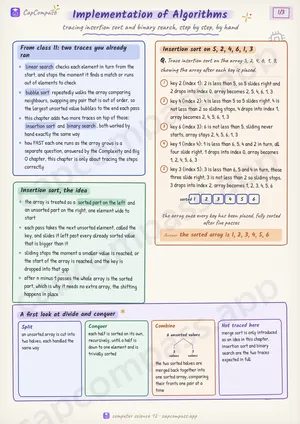
Insertion sort on 5, 2, 4, 6, 1, 3
Q. Trace insertion sort on the array 5, 2, 4, 6, 1, 3, showing the array after each key is placed.
- key 2 (index 1): 2 is less than 5, so 5 slides right and 2 drops into index 0, array becomes 2, 5, 4, 6, 1, 3
- key 4 (index 2): 4 is less than 5 so 5 slides right, 4 is not less than 2 so sliding stops, 4 drops into index 1, array becomes 2, 4, 5, 6, 1, 3
- key 6 (index 3): 6 is not less than 5, sliding never starts, array stays 2, 4, 5, 6, 1, 3
- key 1 (index 4): 1 is less than 6, 5, 4 and 2 in turn, all four slide right, 1 drops into index 0, array becomes 1, 2, 4, 5, 6, 3
- key 3 (index 5): 3 is less than 6, 5 and 4 in turn, those three slide right, 3 is not less than 2 so sliding stops, 3 drops into index 2, array becomes 1, 2, 3, 4, 5, 6
Answer: the sorted array is 1, 2, 3, 4, 5, 6
A first look at divide and conquer
- Split: an unsorted array is cut into two halves, each handled the same way
- Conquer: each half is sorted on its own, recursively, until a half is down to one element and is trivially sorted
- Combine: the two sorted halves are merged back together into one sorted array, comparing their fronts one pair at a time
- Not traced here: merge sort is only introduced as an idea in this chapter, insertion sort and binary search are the two traces expected in full
Page 1 of 3. The full sheet, all 3 pages, opens free in the app.
What this Implementation of Algorithms sheet covers
- From class 11: two traces you already ran
- Insertion sort, the idea
- Insertion sort on 5, 2, 4, 6, 1, 3
- A first look at divide and conquer
- Split
- Conquer
- Combine
- Not traced here
- Binary search needs a sorted array first
- Binary search for 8 in 1, 2, 4, 5, 6, 7, 8, 9
- Linear search against binary search
- Linear search
- Binary search
- Traps that cost marks
- Tricks that save time
How CapCompass uses this sheet
These notes are not a standalone PDF. CapCompass plans Computer Science chapter by chapter against your real exam dates and free hours, and when the plan reaches Implementation of Algorithms the sheet opens inside the study block itself — at the page covering the sub-topic that block is on, with the timer still running. Revision arrives at the moment the plan says revise, instead of having to be gone looking for.