Programming in Java, Reviewed — Class 12 ISC Computer Science revision notes
A 3-page visual revision sheet for Programming in Java, Reviewed, written for Class 12 ISC Computer Science. Formulas, diagrams and the traps that cost marks, laid out to be read the night before rather than the term before. Free, and it opens inside CapCompass.
 Page 1 as PDF
Programming in Java, Reviewed in one look
one dense sheet of everything class 11's Java carries forward
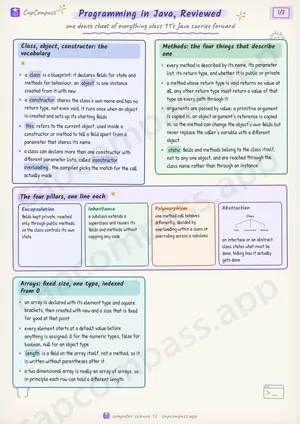
Class, object, constructor: the vocabulary
- a class is a blueprint: it declares fields for state and methods for behaviour, an object is one instance created from it with new
- a constructor shares the class's own name and has no return type, not even void, it runs once when an object is created and sets up its starting fields
- this refers to the current object, used inside a constructor or method to tell a field apart from a parameter that shares its name
- a class can declare more than one constructor with different parameter lists, called constructor overloading, the compiler picks the match for the call actually made
Methods: the four things that describe one
- every method is described by its name, its parameter list, its return type, and whether it is public or private
- a method whose return type is void returns no value at all, any other return type must return a value of that type on every path through it
- arguments are passed by value: a primitive argument is copied in, an object argument's reference is copied in, so the method can change the object's own fields but never replace the caller's variable with a different object
- static fields and methods belong to the class itself, not to any one object, and are reached through the class name rather than through an instance
The four pillars, one line each
- Encapsulation: fields kept private, reached only through public methods, so the class controls its own state
- Inheritance: a subclass extends a superclass and reuses its fields and methods without copying any code
- Polymorphism: one method call behaves differently, decided by overloading within a class or overriding across a subclass
- Abstraction: an interface or an abstract class states what must be done, hiding how it actually gets done
Arrays: fixed size, one type, indexed from 0
- an array is declared with its element type and square brackets, then created with new and a size that is fixed for good at that point
- every element starts at a default value before anything is assigned: 0 for the numeric types, false for boolean, null for an object type
- length is a field on the array itself, not a method, so it is written without parentheses after it
- a two dimensional array is really an array of arrays, so in principle each row can hold a different length
Page 1 of 3. The full sheet, all 3 pages, opens free in the app.
What this Programming in Java, Reviewed sheet covers
- Class, object, constructor: the vocabulary
- Methods: the four things that describe one
- The four pillars, one line each
- Encapsulation
- Inheritance
- Polymorphism
- Abstraction
- Arrays: fixed size, one type, indexed from 0
- Strings: immutable, and not the same as a char array
- One class, a field, a constructor and a method together
- Reading one line of Java at a time
- Declare and create
- Call a method
- A for loop header
- Compare against assign
- A String read as an indexed row of characters
- Traps that cost marks
- Tricks that save time
How CapCompass uses this sheet
These notes are not a standalone PDF. CapCompass plans Computer Science chapter by chapter against your real exam dates and free hours, and when the plan reaches Programming in Java, Reviewed the sheet opens inside the study block itself — at the page covering the sub-topic that block is on, with the timer still running. Revision arrives at the moment the plan says revise, instead of having to be gone looking for.