Units, Rates and Conversions — Digital SAT SAT Math revision notes
A 3-page visual revision sheet for Units, Rates and Conversions, written for Digital SAT SAT Math. Formulas, diagrams and the traps that cost marks, laid out to be read the night before rather than the term before. Free, and it opens inside CapCompass.
 Page 1 as PDF
Units, Rates and Conversions in one look
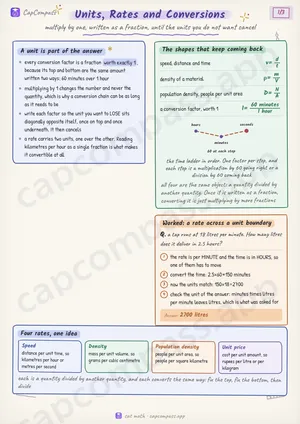
multiply by one, written as a fraction, until the units you do not want cancel
A unit is part of the answer
- every conversion factor is a fraction worth exactly 1, because its top and bottom are the same amount written two ways: 60 minutes over 1 hour
- multiplying by 1 changes the number and never the quantity, which is why a conversion chain can be as long as it needs to be
- write each factor so the unit you want to LOSE sits diagonally opposite itself, once on top and once underneath. It then cancels
- a rate carries two units, one over the other. Reading kilometres per hour as a single fraction is what makes it convertible at all
The shapes that keep coming back
- speed, distance and time
v=d/t - density of a material
ρ=m/V - population density, people per unit area
D=N/A - a conversion factor, worth 1
1=60 minutes/1 hour
Worked: a rate across a unit boundary
Q. a tap runs at 18 litres per minute. How many litres does it deliver in 2.5 hours?
- the rate is per MINUTE and the time is in HOURS, so one of them has to move
- convert the time: 2.5×60=150 minutes
- now the units match: 150×18=2700
- check the unit of the answer: minutes times litres per minute leaves litres, which is what was asked for
Answer: 2700 litres
Four rates, one idea
- Speed: distance per unit time, so kilometres per hour or metres per second
- Density: mass per unit volume, so grams per cubic centimetre
- Population density: people per unit area, so people per square kilometre
- Unit price: cost per unit amount, so rupees per litre or per kilogram
Page 1 of 3. The full sheet, all 3 pages, opens free in the app.
What this Units, Rates and Conversions sheet covers
- A unit is part of the answer
- The shapes that keep coming back
- speed, distance and time
- density of a material
- population density, people per unit area
- a conversion factor, worth 1
- Worked: a rate across a unit boundary
- Four rates, one idea
- Speed
- Density
- Population density
- Unit price
- Worked: a two-part conversion
- Worked: density with mismatched units
- One constant rate, two pictures
- Conversions worth knowing cold
- Where does the conversion belong
- Pacing, the calculator, and typed answers
- Symbols and terms
- Traps that cost points
- Tricks that save time
How CapCompass uses this sheet
These notes are not a standalone PDF. CapCompass plans SAT Math chapter by chapter against your real exam dates and free hours, and when the plan reaches Units, Rates and Conversions the sheet opens inside the study block itself — at the page covering the sub-topic that block is on, with the timer still running. Revision arrives at the moment the plan says revise, instead of having to be gone looking for.
More SAT Math revision notes
- Area and Volume
- Circles
- Equivalent Expressions and Polynomials
- Evaluating Statistical Claims
- Inference and Margin of Error
- Linear Equations
- Linear Functions
- Linear Inequalities
- Lines, Angles, Triangles
- Nonlinear Equations in One Variable
- Nonlinear Functions
- Nonlinear Systems
- One-variable Data
- Percentages
- Probability and Conditional Probability
- Ratios, Rates and Proportions
- Systems of Equations
- Triangles and Trigonometry
- Two-variable Data