Biodiversity, Conservation and Environmental Issues — Class 12 Maharashtra HSC Biology revision notes
A 7-page visual revision sheet for Biodiversity, Conservation and Environmental Issues, written for Class 12 Maharashtra HSC Biology. Formulas, diagrams and the traps that cost marks, laid out to be read the night before rather than the term before. Free, and it opens inside CapCompass.
 Page 1 as PDF
Biodiversity, Conservation and Environmental Issues in one look
three levels of variety, four ways it's being lost, and the pollution problem sitting alongside it
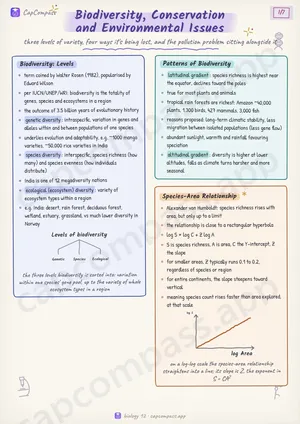
Biodiversity: Levels
- term coined by Walter Rosen (1982), popularised by Edward Wilson
- per IUCN/UNEP/WRI: biodiversity is the totality of genes, species and ecosystems in a region
- the outcome of 3.5 billion years of evolutionary history
- genetic diversity: intraspecific, variation in genes and alleles within and between populations of one species
- underlies evolution and adaptability, e.g. ~1000 mango varieties, ~50,000 rice varieties in India
- species diversity: interspecific, species richness (how many) and species evenness (how individuals distribute)
- India is one of 12 megadiversity nations
- ecological (ecosystem) diversity: variety of ecosystem types within a region
- e.g. India: desert, rain forest, deciduous forest, wetland, estuary, grassland, vs much lower diversity in Norway
Patterns of Biodiversity
- latitudinal gradient: species richness is highest near the equator, declines toward the poles
- true for most plants and animals
- tropical rain forests are richest: Amazon ~40,000 plants, 1,300 birds, 427 mammals, 3,000 fish
- reasons proposed: long-term climatic stability, less migration between isolated populations (less gene flow)
- abundant sunlight, warmth and rainfall favouring speciation
- altitudinal gradient: diversity is higher at lower altitudes, falls as climate turns harsher and more seasonal
Species-Area Relationship
- Alexander von Humboldt: species richness rises with area, but only up to a limit
- the relationship is close to a rectangular hyperbola
- log S = log C + Z log A
- S is species richness, A is area, C the Y-intercept, Z the slope
- for smaller areas, Z typically runs 0.1 to 0.2, regardless of species or region
- for entire continents, the slope steepens toward vertical
- meaning species count rises faster than area explored, at that scale
Page 1 of 7. The full sheet, all 7 pages, opens free in the app.
What this Biodiversity, Conservation and Environmental Issues sheet covers
- Biodiversity: Levels
- Patterns of Biodiversity
- Species-Area Relationship
- Why Species Diversity Matters
- Biodiversity: the Current Scenario
- IUCN Threat Categories, Rising Risk
- The Evil Quartet: Causes of Biodiversity Loss
- Conservation: Why
- In situ vs Ex situ Conservation
- In situ
- Ex situ
- Hotspots and Protected Areas
- Biological Diversity Act, 2002
- Air Pollution
- Electrostatic Precipitator vs Exhaust Gas Scrubber
- Electrostatic precipitator
- Exhaust gas scrubber
- Controlling Vehicular Pollution: Delhi Case Study
- Noise Pollution
- Water Pollution
- Biomagnification
- Solid Waste and Its Management
- Greenhouse Effect and Global Warming
- Ozone Depletion
- Deforestation
- Traps that cost marks
- Tricks that save time
How CapCompass uses this sheet
These notes are not a standalone PDF. CapCompass plans Biology chapter by chapter against your real exam dates and free hours, and when the plan reaches Biodiversity, Conservation and Environmental Issues the sheet opens inside the study block itself — at the page covering the sub-topic that block is on, with the timer still running. Revision arrives at the moment the plan says revise, instead of having to be gone looking for.
More Biology Class 12 revision notes
- Biotechnology
- Control and Co-ordination
- Ecosystems and Energy Flow
- Enhancement of Food Production
- Human Health and Diseases
- Inheritance and Variation
- Molecular Basis of Inheritance
- Organisms and Populations
- Origin and Evolution of Life
- Plant Growth and Mineral Nutrition
- Plant Water Relation
- Reproduction in Lower and Higher Animals
- Reproduction in Lower and Higher Plants
- Respiration and Circulation