Human Health and Diseases — Class 12 Maharashtra HSC Biology revision notes
A 9-page visual revision sheet for Human Health and Diseases, written for Class 12 Maharashtra HSC Biology. Formulas, diagrams and the traps that cost marks, laid out to be read the night before rather than the term before. Free, and it opens inside CapCompass.
 Page 1 as PDF
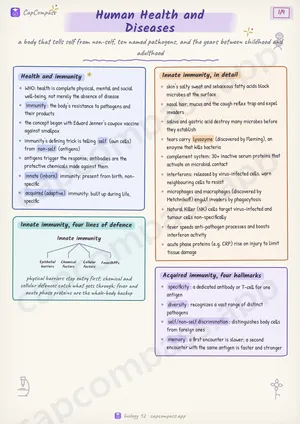
Human Health and Diseases in one look
a body that tells self from non-self, ten named pathogens, and the years between childhood and adulthood
Health and immunity
- WHO: health is complete physical, mental and social well-being, not merely the absence of disease
- immunity: the body's resistance to pathogens and their products
- the concept began with Edward Jenner's cowpox vaccine against smallpox
- immunity's defining trick is telling self (own cells) from non-self (antigens)
- antigens trigger the response; antibodies are the protective chemicals made against them
- innate (inborn) immunity: present from birth, non-specific
- acquired (adaptive) immunity: built up during life, specific
Innate immunity, in detail
- skin's salty sweat and sebaceous fatty acids block microbes at the surface
- nasal hair, mucus and the cough reflex trap and expel invaders
- saliva and gastric acid destroy many microbes before they establish
- tears carry lysozyme (discovered by Fleming), an enzyme that kills bacteria
- complement system: 30+ inactive serum proteins that activate on microbial contact
- interferons: released by virus-infected cells, warn neighbouring cells to resist
- microphages and macrophages (discovered by Metchnikoff) engulf invaders by phagocytosis
- Natural Killer (NK) cells target virus-infected and tumour cells non-specifically
- fever speeds anti-pathogen processes and boosts interferon activity
- acute phase proteins (e.g. CRP) rise on injury to limit tissue damage
Acquired immunity, four hallmarks
- specificity: a dedicated antibody or T-cell for one antigen
- diversity: recognizes a vast range of distinct pathogens
- self/non-self discrimination: distinguishes body cells from foreign ones
- memory: a first encounter is slower; a second encounter with the same antigen is faster and stronger
Page 1 of 9. The full sheet, all 9 pages, opens free in the app.
What this Human Health and Diseases sheet covers
- Health and immunity
- Innate immunity, four lines of defence
- Innate immunity, in detail
- Acquired immunity, four hallmarks
- Active vs Passive Acquired Immunity
- Active
- Passive
- Vaccination
- Cells of the immune system
- The Four T-Cell Types
- Helper T-cells
- Killer (cytotoxic) T-cells
- Suppressor T-cells
- Memory T-cells
- B-lymphocytes and antibody function
- Antibody structure
- ABO Blood Groups
- Rh factor
- Disease, two broad categories
- Vector and Route-Borne Diseases
- Malaria
- Plasmodium's life cycle, split across two hosts
- Sporozoites to liver to RBCs
- Gametocytes to zygote to oocyst
- Sporogony to salivary gland
- Amoebiasis vs Ascariasis
- Amoebiasis (amoebic dysentery)
- Ascariasis
- Filariasis (elephantiasis)
- Respiratory and Food or Water-Borne Diseases
- Diagnosis and treatment, matched
- Dengue
- Cancer, four tissues of origin
- Cancer, benign vs malignant
- Cancer, by Tissue of Origin
- Carcinoma
- Sarcoma
- Lymphoma
- Leukemia
- Causes of cancer
- Cancer Treatment, Four Approaches
- Chemotherapy
- Radiotherapy
- Surgery
- Immunotherapy
- HIV structure
- HIV transmission
- Clinical course of HIV infection
- Initial infection
- Asymptomatic carrier
- AIDS-related complex
- AIDS
- Diagnosis, treatment, prevention
- Adolescence, three stages
- Physical Changes, Boys vs Girls
- Boys
- Girls
- Emotional, social and mental health
- Three plant-derived drug classes
- Three Commonly Abused Drug Classes
- Opioids
- Cannabinoids
- Addiction and dependence
- Effects and prevention
- Abbreviations
- Traps that cost marks
- Tricks that save time
How CapCompass uses this sheet
These notes are not a standalone PDF. CapCompass plans Biology chapter by chapter against your real exam dates and free hours, and when the plan reaches Human Health and Diseases the sheet opens inside the study block itself — at the page covering the sub-topic that block is on, with the timer still running. Revision arrives at the moment the plan says revise, instead of having to be gone looking for.
More Biology Class 12 revision notes
- Biodiversity, Conservation and Environmental Issues
- Biotechnology
- Control and Co-ordination
- Ecosystems and Energy Flow
- Enhancement of Food Production
- Inheritance and Variation
- Molecular Basis of Inheritance
- Organisms and Populations
- Origin and Evolution of Life
- Plant Growth and Mineral Nutrition
- Plant Water Relation
- Reproduction in Lower and Higher Animals
- Reproduction in Lower and Higher Plants
- Respiration and Circulation