Ecosystems and Energy Flow — Class 12 Maharashtra HSC Biology revision notes
A 6-page visual revision sheet for Ecosystems and Energy Flow, written for Class 12 Maharashtra HSC Biology. Formulas, diagrams and the traps that cost marks, laid out to be read the night before rather than the term before. Free, and it opens inside CapCompass.
 Page 1 as PDF
Ecosystems and Energy Flow in one look
one-way energy in, ten percent passed on, and everything else recycled forever
Ecosystem: Structure and Function
- a self-regulating, self-sustaining structural and functional unit of the biosphere
- term coined by Tansley (1935); ranges from a pond to an ocean
- classed as natural (self-sustaining) or artificial (needs constant input), e.g. farm, fish tank
- also classed as terrestrial (forest, grassland, desert) or aquatic (lake, river, sea, estuary)
- four functional processes keep any ecosystem going: productivity, decomposition, nutrient cycling, energy flow
- stratification: vertical layering of species, e.g. trees, shrubs, herbs in a forest
- at sea, stratification runs epipelagic, mesopelagic, bathypelagic and benthic zones by depth
- zonation: horizontal distribution across a gradient, sharpest where land meets water
- e.g. intertidal, littoral, sub-littoral zones at a lake edge or beach
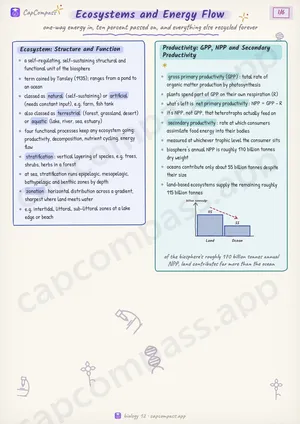
Productivity: GPP, NPP and Secondary Productivity
- gross primary productivity (GPP): total rate of organic matter production by photosynthesis
- plants spend part of GPP on their own respiration (R)
- what's left is net primary productivity: NPP = GPP - R
- it's NPP, not GPP, that heterotrophs actually feed on
- secondary productivity: rate at which consumers assimilate food energy into their bodies
- measured at whichever trophic level the consumer sits
- biosphere's annual NPP is roughly 170 billion tonnes dry weight
- oceans contribute only about 55 billion tonnes despite their size
- land-based ecosystems supply the remaining roughly 115 billion tonnes
Page 1 of 6. The full sheet, all 6 pages, opens free in the app.
What this Ecosystems and Energy Flow sheet covers
- Ecosystem: Structure and Function
- Productivity: GPP, NPP and Secondary Productivity
- Decomposition
- Energy Flow: the Basics
- Grazing Food Chain vs Detritus Food Chain
- Grazing food chain (GFC)
- Detritus food chain (DFC)
- Trophic Levels and the 10% Law
- Energy Reaching the Third Trophic Level
- Ecological Pyramids
- Pyramid Types: Numbers, Biomass, Energy
- Nutrient Cycles (Biogeochemical Cycles)
- Carbon Cycle vs Phosphorus Cycle
- Carbon
- Phosphorus
- Ecological Succession
- Steps of Succession, in Order
- Nudation
- Invasion
- Ecesis
- Aggregation
- Competition and co-action
- Reaction
- Stabilization
- Primary vs Secondary Succession
- Primary succession
- Secondary succession
- Xerarch Succession, Bare Rock to Climax
- Lichens
- Small annuals and lichens
- Perennial herbs, grasses
- Shrubs, shade-intolerant trees
- Shade-tolerant trees
- Ecosystem Services
- Traps that cost marks
- Tricks that save time
How CapCompass uses this sheet
These notes are not a standalone PDF. CapCompass plans Biology chapter by chapter against your real exam dates and free hours, and when the plan reaches Ecosystems and Energy Flow the sheet opens inside the study block itself — at the page covering the sub-topic that block is on, with the timer still running. Revision arrives at the moment the plan says revise, instead of having to be gone looking for.
More Biology Class 12 revision notes
- Biodiversity, Conservation and Environmental Issues
- Biotechnology
- Control and Co-ordination
- Enhancement of Food Production
- Human Health and Diseases
- Inheritance and Variation
- Molecular Basis of Inheritance
- Organisms and Populations
- Origin and Evolution of Life
- Plant Growth and Mineral Nutrition
- Plant Water Relation
- Reproduction in Lower and Higher Animals
- Reproduction in Lower and Higher Plants
- Respiration and Circulation