Reproduction in Lower and Higher Plants — Class 12 Maharashtra HSC Biology revision notes
A 8-page visual revision sheet for Reproduction in Lower and Higher Plants, written for Class 12 Maharashtra HSC Biology. Formulas, diagrams and the traps that cost marks, laid out to be read the night before rather than the term before. Free, and it opens inside CapCompass.
 Page 1 as PDF
Reproduction in Lower and Higher Plants in one look
clones without gametes, then a flower that stakes everything on one pollen tube
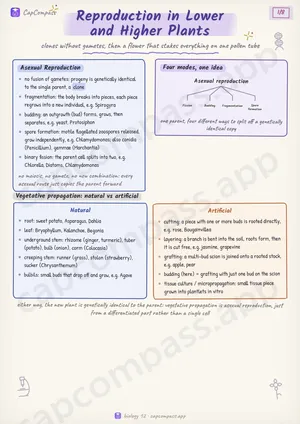
Asexual Reproduction
- no fusion of gametes: progeny is genetically identical to the single parent, a clone
- fragmentation: the body breaks into pieces, each piece regrows into a new individual, e.g. Spirogyra
- budding: an outgrowth (bud) forms, grows, then separates, e.g. yeast, Protosiphon
- spore formation: motile flagellated zoospores released, grow independently, e.g. Chlamydomonas; also conidia (Penicillium), gemmae (Marchantia)
- binary fission: the parent cell splits into two, e.g. Chlorella, Diatoms, Chlamydomonas
Vegetative propagation: natural vs artificial
- root: sweet potato, Asparagus, Dahlia
- leaf: Bryophyllum, Kalanchoe, Begonia
- underground stem: rhizome (ginger, turmeric), tuber (potato), bulb (onion), corm (Colocasia)
- creeping stem: runner (grass), stolon (strawberry), sucker (Chrysanthemum)
- bulbils: small buds that drop off and grow, e.g. Agave
- cutting: a piece with one or more buds is rooted directly, e.g. rose, Bougainvillea
- layering: a branch is bent into the soil, roots form, then it is cut free, e.g. jasmine, grapevine
- grafting: a multi-bud scion is joined onto a rooted stock, e.g. apple, pear
- budding (here) = grafting with just one bud on the scion
- tissue culture / micropropagation: small tissue piece grown into plantlets in vitro
Page 1 of 8. The full sheet, all 8 pages, opens free in the app.
What this Reproduction in Lower and Higher Plants sheet covers
- Asexual Reproduction
- Four modes, one idea
- Vegetative propagation: natural vs artificial
- Natural
- Artificial
- Vegetative propagation: worth it or not
- Advantages
- Disadvantages
- Structure of Flower
- Anther wall, four layers
- Microsporogenesis
- Microspore mother cell
- Microspore tetrad
- Pollen grain
- Pollen grain and viability
- The male gametophyte
- Structure of the anatropous ovule
- Megasporogenesis
- Megaspore mother cell
- Linear tetrad
- Functional megaspore
- The mature embryo sac: 7 cells, 8 nuclei
- Pollination
- Pollination, abiotic and biotic agents
- Autogamy vs Geitonogamy vs Xenogamy
- Autogamy and Geitonogamy
- Xenogamy
- Why Outbreeding Matters
- Outbreeding devices
- Pollination Syndromes
- Pollen Pistil Interaction
- Emasculation and Bagging
- Double Fertilisation
- Double Fertilization
- Syngamy
- Triple fusion
- Types of endosperm development
- Nuclear
- Cellular
- Endosperm types, by prevalence
- Development of Embryo
- Seed and Fruit Development
- Abbreviations
- Apomixis
- Adventive embryony and parthenocarpy
- Polyembryony, and why these three matter
- Traps that cost marks
- Tricks that save time
How CapCompass uses this sheet
These notes are not a standalone PDF. CapCompass plans Biology chapter by chapter against your real exam dates and free hours, and when the plan reaches Reproduction in Lower and Higher Plants the sheet opens inside the study block itself — at the page covering the sub-topic that block is on, with the timer still running. Revision arrives at the moment the plan says revise, instead of having to be gone looking for.
More Biology Class 12 revision notes
- Biodiversity, Conservation and Environmental Issues
- Biotechnology
- Control and Co-ordination
- Ecosystems and Energy Flow
- Enhancement of Food Production
- Human Health and Diseases
- Inheritance and Variation
- Molecular Basis of Inheritance
- Organisms and Populations
- Origin and Evolution of Life
- Plant Growth and Mineral Nutrition
- Plant Water Relation
- Reproduction in Lower and Higher Animals
- Respiration and Circulation