Boundaries and Punctuation — Digital SAT SAT Reading and Writing revision notes
A 4-page visual revision sheet for Boundaries and Punctuation, written for Digital SAT SAT Reading and Writing. Formulas, diagrams and the traps that cost marks, laid out to be read the night before rather than the term before. Free, and it opens inside CapCompass.
 Page 1 as PDF
Boundaries and Punctuation in one look
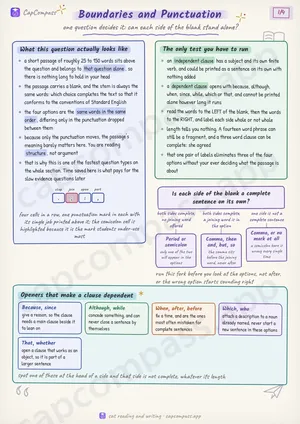
one question decides it: can each side of the blank stand alone?
What this question actually looks like
- a short passage of roughly 25 to 150 words sits above the question and belongs to that question alone, so there is nothing long to hold in your head
- the passage carries a blank, and the stem is always the same words: which choice completes the text so that it conforms to the conventions of Standard English
- the four options are the same words in the same order, differing only in the punctuation dropped between them
- because only the punctuation moves, the passage's meaning barely matters here. You are reading structure, not argument
- that is why this is one of the fastest question types on the whole section. Time saved here is what pays for the slow evidence questions later
The only test you have to run
- an independent clause has a subject and its own finite verb, and could be printed as a sentence on its own with nothing added
- a dependent clause opens with because, although, when, since, while, which or that, and cannot be printed alone however long it runs
- read the words to the LEFT of the blank, then the words to the RIGHT, and label each side whole or not whole
- length tells you nothing. A fourteen word phrase can still be a fragment, and a three word clause can be complete: she agreed
- that one pair of labels eliminates three of the four options without your ever deciding what the passage is about
Is each side of the blank a complete sentence on its own?
- both sides complete, no joining word offered — Period or semicolon: only one of the two will appear in the options
- both sides complete, a joining word is in the option — Comma, then and, but, so: the comma sits before the joining word, never after
- one side is not a complete sentence — Comma, or no mark at all: a semicolon here is wrong every single time
Openers that make a clause dependent
- Because, since: give a reason, so the clause needs a main clause beside it to lean on
- Although, while: concede something, and can never close a sentence by themselves
- When, after, before: fix a time, and are the ones most often mistaken for complete sentences
- Which, who: attach a description to a noun already named, never start a new sentence in these options
- That, whether: open a clause that works as an object, so it is part of a larger sentence
Page 1 of 4. The full sheet, all 4 pages, opens free in the app.
What this Boundaries and Punctuation sheet covers
- What this question actually looks like
- The only test you have to run
- Openers that make a clause dependent
- Because, since
- Although, while
- When, after, before
- Which, who
- That, whether
- Every mark, by the one job it does
- Supplements and the matching pair rule
- Three trap names worth knowing by sight
- The two marks people mix up
- Semicolon
- Colon
- One question, fully worked
- A supplement question, same method
- Commas that are not boundary commas
- Where the boundary actually falls
- The check, in a fixed order
- Traps that cost marks
- Tricks that save time
How CapCompass uses this sheet
These notes are not a standalone PDF. CapCompass plans SAT Reading and Writing chapter by chapter against your real exam dates and free hours, and when the plan reaches Boundaries and Punctuation the sheet opens inside the study block itself — at the page covering the sub-topic that block is on, with the timer still running. Revision arrives at the moment the plan says revise, instead of having to be gone looking for.