Reading Strategy and Pacing — Digital SAT SAT Reading and Writing revision notes
A 5-page visual revision sheet for Reading Strategy and Pacing, written for Digital SAT SAT Reading and Writing. Formulas, diagrams and the traps that cost marks, laid out to be read the night before rather than the term before. Free, and it opens inside CapCompass.
 Page 1 as PDF
Reading Strategy and Pacing in one look
54 questions, 64 minutes, and a plan for where every second goes
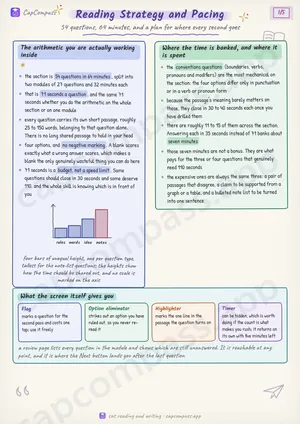
The arithmetic you are actually working inside
- the section is 54 questions in 64 minutes, split into two modules of 27 questions and 32 minutes each
- that is 71 seconds a question, and the same 71 seconds whether you do the arithmetic on the whole section or on one module
- every question carries its own short passage, roughly 25 to 150 words, belonging to that question alone. There is no long shared passage to hold in your head
- four options, and no negative marking. A blank scores exactly what a wrong answer scores, which makes a blank the only genuinely wasteful thing you can do here
- 71 seconds is a budget, not a speed limit. Some questions should close in 30 seconds and some deserve 110, and the whole skill is knowing which is in front of you
Where the time is banked, and where it is spent
- the conventions questions (boundaries, verbs, pronouns and modifiers) are the most mechanical on the section: the four options differ only in punctuation or in a verb or pronoun form
- because the passage's meaning barely matters on those, they close in 30 to 40 seconds each once you have drilled them
- there are roughly 11 to 15 of them across the section. Answering each in 35 seconds instead of 71 banks about seven minutes
- those seven minutes are not a bonus. They are what pays for the three or four questions that genuinely need 110 seconds
- the expensive ones are always the same three: a pair of passages that disagree, a claim to be supported from a graph or a table, and a bulleted note list to be turned into one sentence
What the screen itself gives you
- Flag: marks a question for the second pass and costs one tap; use it freely
- Option eliminator: strikes out an option you have ruled out, so you never re-read it
- Highlighter: marks the one line in the passage the question turns on
- Timer: can be hidden, which is worth doing if the count is what makes you rush; it returns on its own with five minutes left
Page 1 of 5. The full sheet, all 5 pages, opens free in the app.
What this Reading Strategy and Pacing sheet covers
- The arithmetic you are actually working inside
- Where the time is banked, and where it is spent
- What the screen itself gives you
- Flag
- Option eliminator
- Highlighter
- Timer
- The section is adaptive: what that does
- How a module is laid out, and why it matters
- The clock, checked three times and no more
- Our own second targets, by question type
- The two-pass method inside one module
- Eliminating, when you cannot simply see the answer
- Transitions: a 45 second question, always
- When the question hands you a graph or a table
- A words in context question, worked at speed
- Traps that cost marks
- Tricks that save time
How CapCompass uses this sheet
These notes are not a standalone PDF. CapCompass plans SAT Reading and Writing chapter by chapter against your real exam dates and free hours, and when the plan reaches Reading Strategy and Pacing the sheet opens inside the study block itself — at the page covering the sub-topic that block is on, with the timer still running. Revision arrives at the moment the plan says revise, instead of having to be gone looking for.