Verbs: Form and Sense — Digital SAT SAT Reading and Writing revision notes
A 4-page visual revision sheet for Verbs: Form and Sense, written for Digital SAT SAT Reading and Writing. Formulas, diagrams and the traps that cost marks, laid out to be read the night before rather than the term before. Free, and it opens inside CapCompass.
 Page 1 as PDF
Verbs: Form and Sense in one look
find the real subject, fix the real time, and the option set collapses
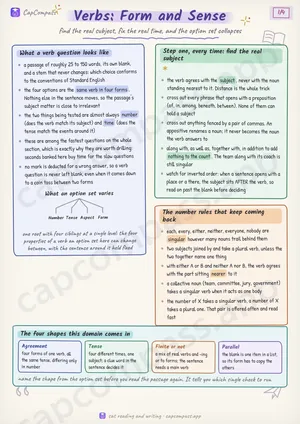
What a verb question looks like
- a passage of roughly 25 to 150 words, its own blank, and a stem that never changes: which choice conforms to the conventions of Standard English
- the four options are the same verb in four forms. Nothing else in the sentence moves, so the passage's subject matter is close to irrelevant
- the two things being tested are almost always number (does the verb match its subject) and time (does the tense match the events around it)
- these are among the fastest questions on the whole section, which is exactly why they are worth drilling: seconds banked here buy time for the slow questions
- no mark is deducted for a wrong answer, so a verb question is never left blank, even when it comes down to a coin toss between two forms
Step one, every time: find the real subject
- the verb agrees with the subject, never with the noun standing nearest to it. Distance is the whole trick
- cross out every phrase that opens with a preposition (of, in, among, beneath, between). None of them can hold a subject
- cross out anything fenced by a pair of commas. An appositive renames a noun; it never becomes the noun the verb answers to
- along with, as well as, together with, in addition to add nothing to the count. The team along with its coach is still singular
- watch for inverted order: when a sentence opens with a place or a there, the subject sits AFTER the verb, so read on past the blank before deciding
The number rules that keep coming back
- each, every, either, neither, everyone, nobody are singular however many nouns trail behind them
- two subjects joined by and take a plural verb, unless the two together name one thing
- with either A or B and neither A nor B, the verb agrees with the part sitting nearer to it
- a collective noun (team, committee, jury, government) takes a singular verb when it acts as one body
- the number of X takes a singular verb, a number of X takes a plural one. That pair is offered often and read fast
The four shapes this domain comes in
- Agreement: four forms of one verb, all the same tense, differing only in number
- Tense: four different times, one subject; a clue word in the sentence decides it
- Finite or not: a mix of real verbs and -ing or to forms; the sentence needs a main verb
- Parallel: the blank is one item in a list, so its form has to copy the others
Page 1 of 4. The full sheet, all 4 pages, opens free in the app.
What this Verbs: Form and Sense sheet covers
- What a verb question looks like
- Step one, every time: find the real subject
- The number rules that keep coming back
- The four shapes this domain comes in
- Agreement
- Tense
- Finite or not
- Parallel
- Subjects that get counted wrongly
- An agreement question, fully worked
- Agreement inside a who or that clause
- Step two: fix the time from the clues
- A tense question, fully worked
- The two past forms people confuse
- Simple past
- Present perfect
- Form: when the blank needs no tense at all
- Clue words, and the tense each one demands
- Traps that cost marks
- Tricks that save time
How CapCompass uses this sheet
These notes are not a standalone PDF. CapCompass plans SAT Reading and Writing chapter by chapter against your real exam dates and free hours, and when the plan reaches Verbs: Form and Sense the sheet opens inside the study block itself — at the page covering the sub-topic that block is on, with the timer still running. Revision arrives at the moment the plan says revise, instead of having to be gone looking for.