Probability — Class 11 CBSE Mathematics revision notes
A 5-page visual revision sheet for Probability, written for Class 11 CBSE Mathematics. Formulas, diagrams and the traps that cost marks, laid out to be read the night before rather than the term before. Free, and it opens inside CapCompass.
 Page 1 as PDF
Probability in one look
sample space, events, and the three rules everything else is built from
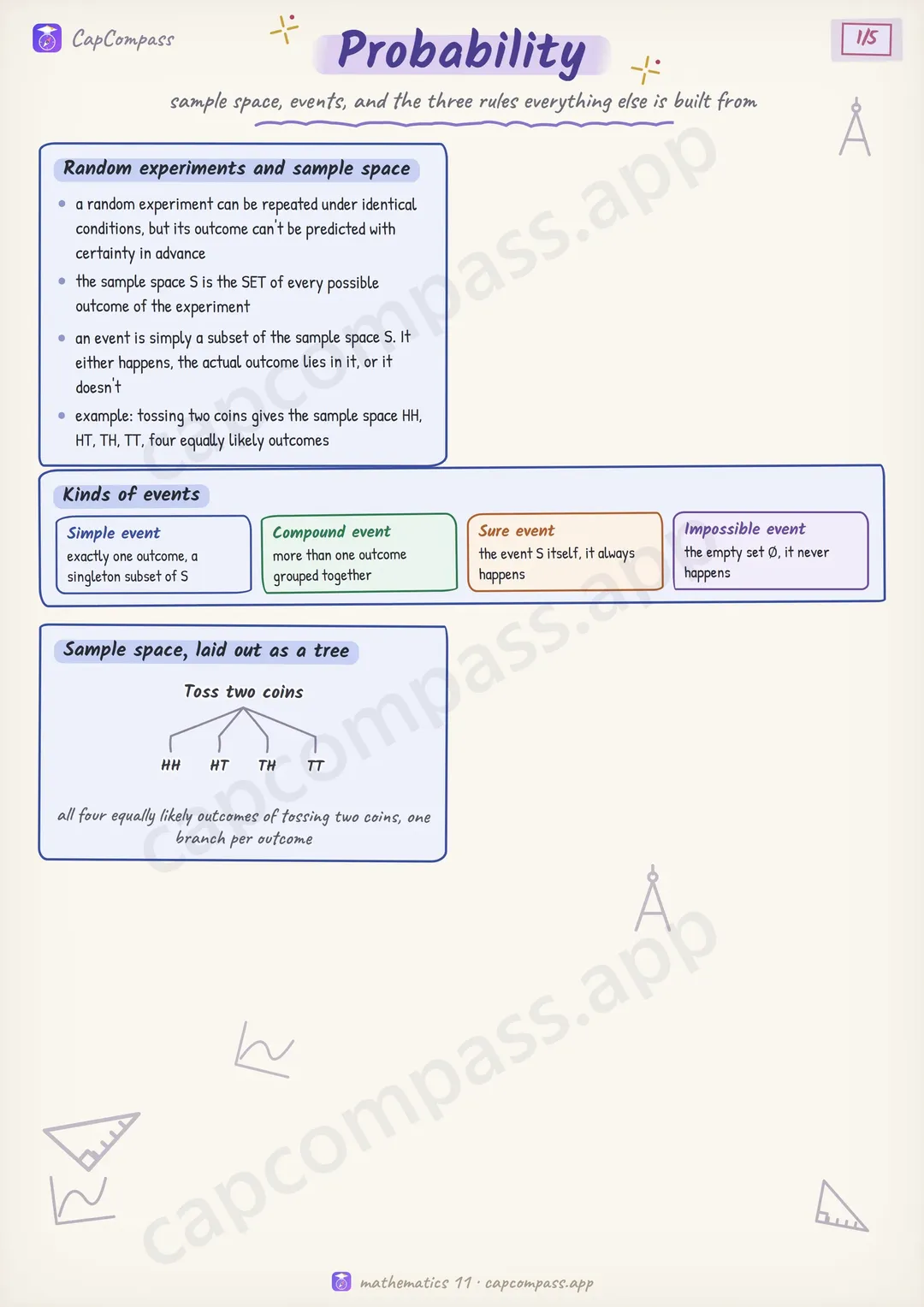
Random experiments and sample space
- a random experiment can be repeated under identical conditions, but its outcome can't be predicted with certainty in advance
- the sample space S is the SET of every possible outcome of the experiment
- an event is simply a subset of the sample space S. It either happens, the actual outcome lies in it, or it doesn't
- example: tossing two coins gives the sample space HH, HT, TH, TT, four equally likely outcomes
Kinds of events
- Simple event: exactly one outcome, a singleton subset of S
- Compound event: more than one outcome grouped together
- Sure event: the event S itself, it always happens
- Impossible event: the empty set ∅, it never happens
Page 1 of 5. The full sheet, all 5 pages, opens free in the app.
What this Probability sheet covers
- Random experiments and sample space
- Kinds of events
- Simple event
- Compound event
- Sure event
- Impossible event
- Sample space, laid out as a tree
- Combining events
- Two events, and where they meet
- More than two events
- The axioms of probability
- probability is never negative and never exceeds 1
- the sure event has probability 1
- mutually exclusive events add directly, A∩B=∅
- Consequences worth knowing
- the impossible event
- complement rule
- equally likely outcomes, the classical case
- Worked: probability from equally likely outcomes
- The addition rule
- general case, any two events
- mutually exclusive events, the special case P(A∩B)=0
- three events, general case
- Which addition rule applies
- Worked: addition rule with overlapping events
- Symbols
- Traps that cost marks
- Tricks that save time
How CapCompass uses this sheet
These notes are not a standalone PDF. CapCompass plans Mathematics chapter by chapter against your real exam dates and free hours, and when the plan reaches Probability the sheet opens inside the study block itself — at the page covering the sub-topic that block is on, with the timer still running. Revision arrives at the moment the plan says revise, instead of having to be gone looking for.