Permutations and Combinations — Class 11 CBSE Mathematics revision notes
A 3-page visual revision sheet for Permutations and Combinations, written for Class 11 CBSE Mathematics. Formulas, diagrams and the traps that cost marks, laid out to be read the night before rather than the term before. Free, and it opens inside CapCompass.
 Page 1 as PDF
Permutations and Combinations in one look
counting without listing, whether order matters or not
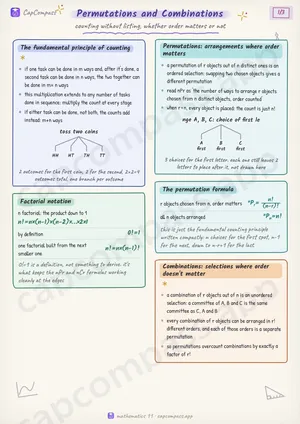
The fundamental principle of counting
- if one task can be done in m ways and, after it's done, a second task can be done in n ways, the two together can be done in m× n ways
- this multiplication extends to any number of tasks done in sequence: multiply the count at every stage
- if either task can be done, not both, the counts add instead: m+n ways
Factorial notation
- n factorial: the product down to 1
n!=n×(n-1)×(n-2)×…× 2× 1 - by definition
0!=1 - one factorial built from the next smaller one
n!=n×(n-1)!
Permutations: arrangements where order matters
- a permutation of r objects out of n distinct ones is an ordered selection: swapping two chosen objects gives a different permutation
- read nPr as 'the number of ways to arrange r objects chosen from n distinct objects, order counted'
- when r=n, every object is placed: the count is just n!
The permutation formula
- r objects chosen from n, order matters
^nP_r=n!/(n-r)! - all n objects arranged
^nP_n=n!
Combinations: selections where order doesn't matter
- a combination of r objects out of n is an unordered selection: a committee of A, B and C is the same committee as C, A and B
- every combination of r objects can be arranged in r! different orders, and each of those orders is a separate permutation
- so permutations overcount combinations by exactly a factor of r!
Page 1 of 3. The full sheet, all 3 pages, opens free in the app.
What this Permutations and Combinations sheet covers
- The fundamental principle of counting
- Factorial notation
- n factorial: the product down to 1
- by definition
- one factorial built from the next smaller one
- Permutations: arrangements where order matters
- The permutation formula
- r objects chosen from n, order matters
- all n objects arranged
- Combinations: selections where order doesn't matter
- The combination formula
- r objects chosen from n, order ignored
- the link between the two
- symmetry: choosing r is the same count as choosing what's left out
- Permutation or combination
- Choosing 4 of 6, two different questions
- Repetition and objects that aren't all distinct
- Arranging letters with repeats
- Symbols
- Traps that cost marks
- Tricks that save time
How CapCompass uses this sheet
These notes are not a standalone PDF. CapCompass plans Mathematics chapter by chapter against your real exam dates and free hours, and when the plan reaches Permutations and Combinations the sheet opens inside the study block itself — at the page covering the sub-topic that block is on, with the timer still running. Revision arrives at the moment the plan says revise, instead of having to be gone looking for.