Waves — Class 11 CBSE Physics revision notes
A 6-page visual revision sheet for Waves, written for Class 11 CBSE Physics. Formulas, diagrams and the traps that cost marks, laid out to be read the night before rather than the term before. Free, and it opens inside CapCompass.
 Page 1 as PDF
Waves in one look
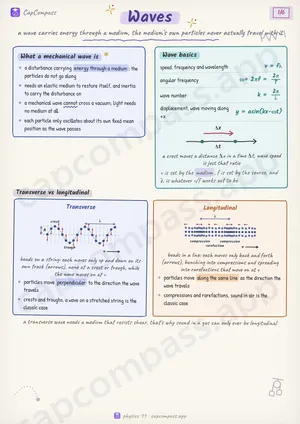
a wave carries energy through a medium, the medium's own particles never actually travel with it
What a mechanical wave is
- a disturbance carrying energy through a medium; the particles do not go along
- needs an elastic medium to restore itself, and inertia to carry the disturbance on
- a mechanical wave cannot cross a vacuum; light needs no medium at all
- each particle only oscillates about its own fixed mean position as the wave passes
Wave basics
- speed, frequency and wavelength
v = fλ - angular frequency
ω = 2π f = 2π/T - wave number
k = 2π/λ - displacement, wave moving along +x
y = asin(kx-ω t)
Transverse vs longitudinal
- particles move perpendicular to the direction the wave travels
- crests and troughs, a wave on a stretched string is the classic case
- particles move along the same line as the direction the wave travels
- compressions and rarefactions, sound in air is the classic case
Page 1 of 6. The full sheet, all 6 pages, opens free in the app.
What this Waves sheet covers
- What a mechanical wave is
- Wave basics
- speed, frequency and wavelength
- angular frequency
- wave number
- displacement, wave moving along +x
- Transverse vs longitudinal
- Transverse
- Longitudinal
- Speed of a wave on a string
- Speed formulas: elastic over inertial
- any mechanical wave
- transverse wave on a string, tension T, linear density μ
- longitudinal wave in a fluid, bulk modulus B
- sound in a gas, Laplace's correction
- Reflection of waves
- Principle of superposition
- Interference of two waves
- two waves, same f and amplitude a, phase difference φ
- resultant amplitude
- phase difference from a path difference Δ
- Standing waves
- Standing waves on a string, both ends fixed
- allowed wavelengths, n = 1, 2, 3...
- allowed frequencies
- fundamental, the first harmonic
- In the lab: the sonometer
- Standing waves in air columns
- pipe closed at one end: node at the closed end, antinode at the open end
- pipe open at both ends: antinodes at both ends
- In the lab: the resonance tube
- Which harmonics sound
- Beats
- The Doppler effect
- Doppler formula
- observer speed v_o, source speed v_s, wave speed v
- Symbols
- Traps that cost marks
- Tricks that save time
How CapCompass uses this sheet
These notes are not a standalone PDF. CapCompass plans Physics chapter by chapter against your real exam dates and free hours, and when the plan reaches Waves the sheet opens inside the study block itself — at the page covering the sub-topic that block is on, with the timer still running. Revision arrives at the moment the plan says revise, instead of having to be gone looking for.