Computer Networks — Class 12 CBSE Computer Science revision notes
A 3-page visual revision sheet for Computer Networks, written for Class 12 CBSE Computer Science. Formulas, diagrams and the traps that cost marks, laid out to be read the night before rather than the term before. Free, and it opens inside CapCompass.
 Page 1 as PDF
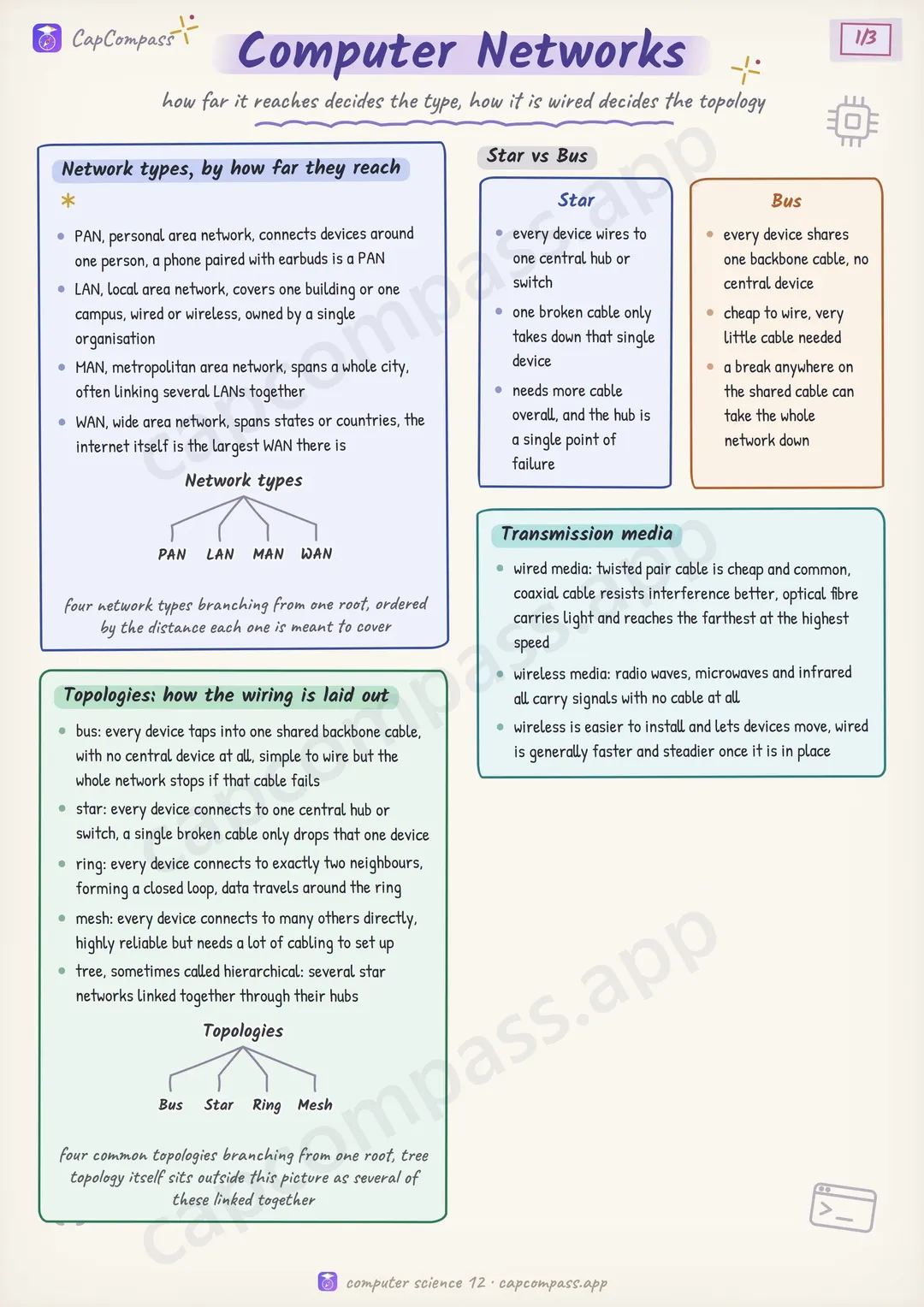
Computer Networks in one look
how far it reaches decides the type, how it is wired decides the topology
Network types, by how far they reach
- PAN, personal area network, connects devices around one person, a phone paired with earbuds is a PAN
- LAN, local area network, covers one building or one campus, wired or wireless, owned by a single organisation
- MAN, metropolitan area network, spans a whole city, often linking several LANs together
- WAN, wide area network, spans states or countries, the internet itself is the largest WAN there is
Topologies: how the wiring is laid out
- bus: every device taps into one shared backbone cable, with no central device at all, simple to wire but the whole network stops if that cable fails
- star: every device connects to one central hub or switch, a single broken cable only drops that one device
- ring: every device connects to exactly two neighbours, forming a closed loop, data travels around the ring
- mesh: every device connects to many others directly, highly reliable but needs a lot of cabling to set up
- tree, sometimes called hierarchical: several star networks linked together through their hubs
Star vs Bus
- every device wires to one central hub or switch
- one broken cable only takes down that single device
- needs more cable overall, and the hub is a single point of failure
- every device shares one backbone cable, no central device
- cheap to wire, very little cable needed
- a break anywhere on the shared cable can take the whole network down
Transmission media
- wired media: twisted pair cable is cheap and common, coaxial cable resists interference better, optical fibre carries light and reaches the farthest at the highest speed
- wireless media: radio waves, microwaves and infrared all carry signals with no cable at all
- wireless is easier to install and lets devices move, wired is generally faster and steadier once it is in place
Page 1 of 3. The full sheet, all 3 pages, opens free in the app.
What this Computer Networks sheet covers
- Network types, by how far they reach
- Topologies: how the wiring is laid out
- Star vs Bus
- Star
- Bus
- Transmission media
- Network devices
- Picking the right protocol
- Client-server, in outline
- A little network security
- Traps that cost marks
- Tricks that save time
How CapCompass uses this sheet
These notes are not a standalone PDF. CapCompass plans Computer Science chapter by chapter against your real exam dates and free hours, and when the plan reaches Computer Networks the sheet opens inside the study block itself — at the page covering the sub-topic that block is on, with the timer still running. Revision arrives at the moment the plan says revise, instead of having to be gone looking for.