Data Structures: Stack — Class 12 CBSE Computer Science revision notes
A 3-page visual revision sheet for Data Structures: Stack, written for Class 12 CBSE Computer Science. Formulas, diagrams and the traps that cost marks, laid out to be read the night before rather than the term before. Free, and it opens inside CapCompass.
 Page 1 as PDF
Data Structures: Stack in one look
the last thing pushed in is always the first thing that comes back out
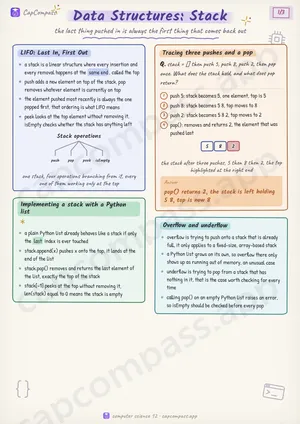
LIFO: Last In, First Out
- a stack is a linear structure where every insertion and every removal happens at the same end, called the top
- push adds a new element on top of the stack, pop removes whatever element is currently on top
- the element pushed most recently is always the one popped first, that ordering is what LIFO means
- peek looks at the top element without removing it, isEmpty checks whether the stack has anything left
Implementing a stack with a Python list
- a plain Python list already behaves like a stack if only the last index is ever touched
- stack.append(x) pushes x onto the top, it lands at the end of the list
- stack.pop() removes and returns the last element of the list, exactly the top of the stack
- stack[-1] peeks at the top without removing it, len(stack) equal to 0 means the stack is empty
Tracing three pushes and a pop
Q. stack = [] then push 5, push 8, push 2, then pop once. What does the stack hold, and what does pop return?
- push 5: stack becomes 5, one element, top is 5
- push 8: stack becomes 5 8, top moves to 8
- push 2: stack becomes 5 8 2, top moves to 2
- pop(): removes and returns 2, the element that was pushed last
Answer: pop() returns 2, the stack is left holding 5 8, top is now 8
Overflow and underflow
- overflow is trying to push onto a stack that is already full, it only applies to a fixed-size, array-based stack
- a Python list grows on its own, so overflow there only shows up as running out of memory, an unusual case
- underflow is trying to pop from a stack that has nothing in it, that is the case worth checking for every time
- calling pop() on an empty Python list raises an error, so isEmpty should be checked before every pop
Page 1 of 3. The full sheet, all 3 pages, opens free in the app.
What this Data Structures: Stack sheet covers
- LIFO: Last In, First Out
- Implementing a stack with a Python list
- Tracing three pushes and a pop
- Overflow and underflow
- Stack application: expression evaluation
- Reading one token of an expression
- Other applications built on the same idea
- Checking balanced brackets
- Push vs Pop
- Push
- Pop
- Traps that cost marks
- Tricks that save time
How CapCompass uses this sheet
These notes are not a standalone PDF. CapCompass plans Computer Science chapter by chapter against your real exam dates and free hours, and when the plan reaches Data Structures: Stack the sheet opens inside the study block itself — at the page covering the sub-topic that block is on, with the timer still running. Revision arrives at the moment the plan says revise, instead of having to be gone looking for.