Arrays and Strings — Class 11 ISC Computer Science revision notes
A 3-page visual revision sheet for Arrays and Strings, written for Class 11 ISC Computer Science. Formulas, diagrams and the traps that cost marks, laid out to be read the night before rather than the term before. Free, and it opens inside CapCompass.
 Page 1 as PDF
Arrays and Strings in one look
a row of fixed slots, and the one object that never lets you edit its own characters
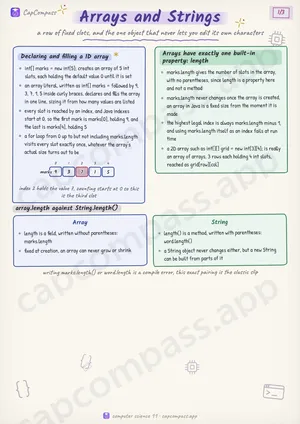
Declaring and filling a 1D array
- int[] marks = new int[5]; creates an array of 5 int slots, each holding the default value 0 until it is set
- an array literal, written as int[] marks = followed by 9, 3, 7, 1, 5 inside curly braces, declares and fills the array in one line, sizing it from how many values are listed
- every slot is reached by an index, and Java indexes start at 0, so the first mark is marks[0], holding 9, and the last is marks[4], holding 5
- a for loop from 0 up to but not including marks.length visits every slot exactly once, whatever the array's actual size turns out to be
Arrays have exactly one built-in property: length
- marks.length gives the number of slots in the array, with no parentheses, since length is a property here and not a method
- marks.length never changes once the array is created, an array in Java is a fixed size from the moment it is made
- the highest legal index is always marks.length minus 1, and using marks.length itself as an index fails at run time
- a 2D array such as int[][] grid = new int[3][4]; is really an array of arrays, 3 rows each holding 4 int slots, reached as grid[row][col]
array.length against String.length()
- length is a field, written without parentheses: marks.length
- fixed at creation, an array can never grow or shrink
- length() is a method, written with parentheses: word.length()
- a String object never changes either, but a new String can be built from parts of it
Page 1 of 3. The full sheet, all 3 pages, opens free in the app.
What this Arrays and Strings sheet covers
- Declaring and filling a 1D array
- Arrays have exactly one built-in property: length
- array.length against String.length()
- Array
- String
- Strings are objects, and they never change
- The String methods that come up again and again
- equals() against ==, on Strings
- equals()
- ==
- 2D arrays and StringBuilder, briefly
- Tracing a sum and a running largest
- Traps that cost marks
- Tricks that save time
How CapCompass uses this sheet
These notes are not a standalone PDF. CapCompass plans Computer Science chapter by chapter against your real exam dates and free hours, and when the plan reaches Arrays and Strings the sheet opens inside the study block itself — at the page covering the sub-topic that block is on, with the timer still running. Revision arrives at the moment the plan says revise, instead of having to be gone looking for.
More Computer Science Class 11 revision notes
- Basic Input Output and File Handling
- Encodings
- Implementation of Algorithms
- Introduction to Object Oriented Programming using Java
- Methods and Constructors
- Numbers
- Objects and Classes
- Packages
- Primitive Values, Wrapper Classes and Types
- Propositional Logic and Hardware Implementation
- Recursion
- Statements and Scope
- Trends in Computing and Ethical Issues
- Variables and Expressions