Methods and Constructors — Class 11 ISC Computer Science revision notes
A 3-page visual revision sheet for Methods and Constructors, written for Class 11 ISC Computer Science. Formulas, diagrams and the traps that cost marks, laid out to be read the night before rather than the term before. Free, and it opens inside CapCompass.
 Page 1 as PDF
Methods and Constructors in one look
one named block of code, and the special one that builds the object
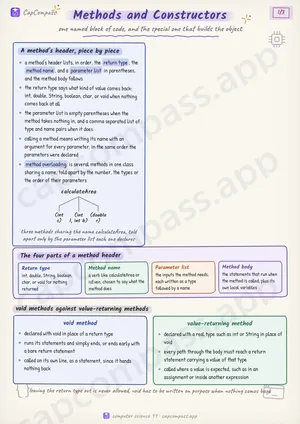
A method's header, piece by piece
- a method's header lists, in order, the return type, the method name, and a parameter list in parentheses, and the method body follows
- the return type says what kind of value comes back: int, double, String, boolean, char, or void when nothing comes back at all
- the parameter list is empty parentheses when the method takes nothing in, and a comma separated list of type and name pairs when it does
- calling a method means writing its name with an argument for every parameter, in the same order the parameters were declared
- method overloading is several methods in one class sharing a name, told apart by the number, the types or the order of their parameters
The four parts of a method header
- Return type: int, double, String, boolean, char, or void for nothing returned
- Method name: a verb like calculateArea or isEven, chosen to say what the method does
- Parameter list: the inputs the method needs, each written as a type followed by a name
- Method body: the statements that run when the method is called, plus its own local variables
void methods against value-returning methods
- declared with void in place of a return type
- runs its statements and simply ends, or ends early with a bare return statement
- called on its own line, as a statement, since it hands nothing back
- declared with a real type such as int or String in place of void
- every path through the body must reach a return statement carrying a value of that type
- called where a value is expected, such as in an assignment or inside another expression
Page 1 of 3. The full sheet, all 3 pages, opens free in the app.
What this Methods and Constructors sheet covers
- A method's header, piece by piece
- The four parts of a method header
- Return type
- Method name
- Parameter list
- Method body
- void methods against value-returning methods
- void method
- value-returning method
- Which overload actually runs
- Constructors set an object up
- this, said plainly
- Building an object, in order
- new is written
- fields take default values
- the matching constructor runs
- a reference comes back
- Tracing a constructor that calls another
- Traps that cost marks
- Tricks that save time
How CapCompass uses this sheet
These notes are not a standalone PDF. CapCompass plans Computer Science chapter by chapter against your real exam dates and free hours, and when the plan reaches Methods and Constructors the sheet opens inside the study block itself — at the page covering the sub-topic that block is on, with the timer still running. Revision arrives at the moment the plan says revise, instead of having to be gone looking for.
More Computer Science Class 11 revision notes
- Arrays and Strings
- Basic Input Output and File Handling
- Encodings
- Implementation of Algorithms
- Introduction to Object Oriented Programming using Java
- Numbers
- Objects and Classes
- Packages
- Primitive Values, Wrapper Classes and Types
- Propositional Logic and Hardware Implementation
- Recursion
- Statements and Scope
- Trends in Computing and Ethical Issues
- Variables and Expressions