Introduction to Object Oriented Programming using Java — Class 11 ISC Computer Science revision notes
A 3-page visual revision sheet for Introduction to Object Oriented Programming using Java, written for Class 11 ISC Computer Science. Formulas, diagrams and the traps that cost marks, laid out to be read the night before rather than the term before. Free, and it opens inside CapCompass.
 Page 1 as PDF
Introduction to Object Oriented Programming using Java in one look
why classes and objects replace one long list of instructions
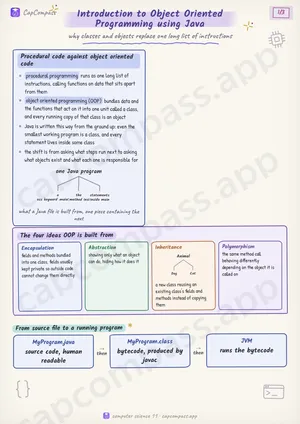
Procedural code against object oriented code
- procedural programming runs as one long list of instructions, calling functions on data that sits apart from them
- object oriented programming (OOP) bundles data and the functions that act on it into one unit called a class, and every running copy of that class is an object
- Java is written this way from the ground up: even the smallest working program is a class, and every statement lives inside some class
- the shift is from asking what steps run next to asking what objects exist and what each one is responsible for
The four ideas OOP is built from
- Encapsulation: fields and methods bundled into one class, fields usually kept private so outside code cannot change them directly
- Abstraction: showing only what an object can do, hiding how it does it
- Inheritance: a new class reusing an existing class's fields and methods instead of copying them
- Polymorphism: the same method call behaving differently depending on the object it is called on
From source file to a running program
- MyProgram.java
- MyProgram.class
- JVM
Page 1 of 3. The full sheet, all 3 pages, opens free in the app.
What this Introduction to Object Oriented Programming using Java sheet covers
- Procedural code against object oriented code
- The four ideas OOP is built from
- Encapsulation
- Abstraction
- Inheritance
- Polymorphism
- From source file to a running program
- MyProgram.java
- MyProgram.class
- JVM
- Reading the main method signature
- Tracing the smallest working Java program
- What main's signature must declare
- Words the question will use
- javac and java, what each does
- Traps that cost marks
- Tricks that save time
How CapCompass uses this sheet
These notes are not a standalone PDF. CapCompass plans Computer Science chapter by chapter against your real exam dates and free hours, and when the plan reaches Introduction to Object Oriented Programming using Java the sheet opens inside the study block itself — at the page covering the sub-topic that block is on, with the timer still running. Revision arrives at the moment the plan says revise, instead of having to be gone looking for.
More Computer Science Class 11 revision notes
- Arrays and Strings
- Basic Input Output and File Handling
- Encodings
- Implementation of Algorithms
- Methods and Constructors
- Numbers
- Objects and Classes
- Packages
- Primitive Values, Wrapper Classes and Types
- Propositional Logic and Hardware Implementation
- Recursion
- Statements and Scope
- Trends in Computing and Ethical Issues
- Variables and Expressions