Biodiversity and Conservation — Class 12 CBSE Biology revision notes
A 4-page visual revision sheet for Biodiversity and Conservation, written for Class 12 CBSE Biology. Formulas, diagrams and the traps that cost marks, laid out to be read the night before rather than the term before. Free, and it opens inside CapCompass.
 Page 1 as PDF
Biodiversity and Conservation in one look
counting species is the easy part, keeping them is not
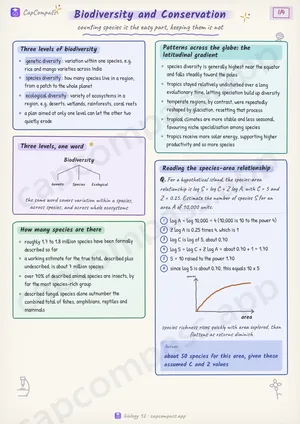
Three levels of biodiversity
- genetic diversity: variation within one species, e.g. rice and mango varieties across India
- species diversity: how many species live in a region, from a patch to the whole planet
- ecological diversity: variety of ecosystems in a region, e.g. deserts, wetlands, rainforests, coral reefs
- a plan aimed at only one level can let the other two quietly erode
How many species are there
- roughly 1.7 to 1.8 million species have been formally described so far
- a working estimate for the true total, described plus undescribed, is about 7 million species
- over 70% of described animal species are insects, by far the most species-rich group
- described fungal species alone outnumber the combined total of fishes, amphibians, reptiles and mammals
Patterns across the globe: the latitudinal gradient
- species diversity is generally highest near the equator and falls steadily toward the poles
- tropics stayed relatively undisturbed over a long evolutionary time, letting speciation build up diversity
- temperate regions, by contrast, were repeatedly reshaped by glaciation, resetting that process
- tropical climates are more stable and less seasonal, favouring niche specialisation among species
- tropics receive more solar energy, supporting higher productivity and so more species
Reading the species-area relationship
Q. For a hypothetical island, the species-area relationship is log S = log C + Z log A, with C = 5 and Z = 0.25. Estimate the number of species S for an area A of 10,000 units.
- log A = log 10,000 = 4 (10,000 is 10 to the power 4)
- Z log A is 0.25 times 4, which is 1
- log C is log of 5, about 0.70
- log S = log C + Z log A = about 0.70 + 1 = 1.70
- S = 10 raised to the power 1.70
- since log 5 is about 0.70, this equals 10 x 5
Answer: about 50 species for this area, given these assumed C and Z values
Page 1 of 4. The full sheet, all 4 pages, opens free in the app.
What this Biodiversity and Conservation sheet covers
- Three levels of biodiversity
- Three levels, one word
- How many species are there
- Patterns across the globe: the latitudinal gradient
- Reading the species-area relationship
- Why every species counts: the rivet popper idea
- Why should biodiversity be conserved
- narrowly utilitarian
- broadly utilitarian
- ethical
- How much biodiversity has been lost
- The Evil Quartet: how biodiversity is actually lost
- Four causes, one outcome
- Two routes to conservation
- In-situ
- Ex-situ
- In-situ, in more detail
- Ex-situ, in more detail
- Traps that cost marks
- Tricks that save time
How CapCompass uses this sheet
These notes are not a standalone PDF. CapCompass plans Biology chapter by chapter against your real exam dates and free hours, and when the plan reaches Biodiversity and Conservation the sheet opens inside the study block itself — at the page covering the sub-topic that block is on, with the timer still running. Revision arrives at the moment the plan says revise, instead of having to be gone looking for.
More Biology Class 12 revision notes
- Biotechnology and its Applications
- Biotechnology: Principles and Processes
- Ecosystem
- Evolution
- Human Health and Disease
- Human Reproduction
- Microbes in Human Welfare
- Molecular Basis of Inheritance
- Organisms and Populations
- Principles of Inheritance and Variation
- Reproductive Health
- Sexual Reproduction in Flowering Plants