Biotechnology: Principles and Processes — Class 12 CBSE Biology revision notes
A 5-page visual revision sheet for Biotechnology: Principles and Processes, written for Class 12 CBSE Biology. Formulas, diagrams and the traps that cost marks, laid out to be read the night before rather than the term before. Free, and it opens inside CapCompass.
 Page 1 as PDF
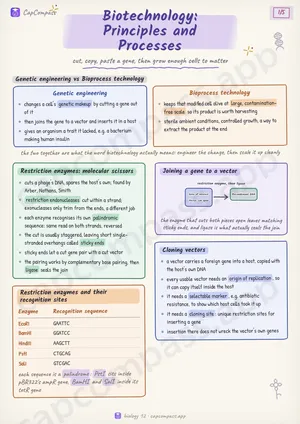
Biotechnology: Principles and Processes in one look
cut, copy, paste a gene, then grow enough cells to matter
Genetic engineering vs Bioprocess technology
- changes a cell's genetic makeup by cutting a gene out of it
- then joins the gene to a vector and inserts it in a host
- gives an organism a trait it lacked, e.g. a bacterium making human insulin
- keeps that modified cell alive at large, contamination-free scale so its product is worth harvesting
- sterile ambient conditions, controlled growth, a way to extract the product at the end
Restriction enzymes: molecular scissors
- cuts a phage's DNA, spares the host's own; found by Arber, Nathans, Smith
- restriction endonucleases cut within a strand; exonucleases only trim from the ends, a different job
- each enzyme recognises its own palindromic sequence: same read on both strands, reversed
- the cut is usually staggered, leaving short single-stranded overhangs called sticky ends
- sticky ends let a cut gene pair with a cut vector
- the pairing works by complementary base pairing, then ligase seals the join
Restriction enzymes and their recognition sites
| Enzyme | Recognition sequence |
|---|---|
| EcoRI | GAATTC |
| BamHI | GGATCC |
| HindIII | AAGCTT |
| PstI | CTGCAG |
| SalI | GTCGAC |
Cloning vectors
- a vector carries a foreign gene into a host, copied with the host's own DNA
- every usable vector needs an origin of replication, so it can copy itself inside the host
- it needs a selectable marker, e.g. antibiotic resistance, to show which host cells took it up
- it needs a cloning site: unique restriction sites for inserting a gene
- insertion there does not wreck the vector's own genes
Page 1 of 5. The full sheet, all 5 pages, opens free in the app.
What this Biotechnology: Principles and Processes sheet covers
- Genetic engineering vs Bioprocess technology
- Genetic engineering
- Bioprocess technology
- Restriction enzymes: molecular scissors
- Restriction enzymes and their recognition sites
- Joining a gene to a vector
- Cloning vectors
- The main families of vector
- Plasmid vector vs Bacteriophage vector
- Plasmid vector
- Bacteriophage vector
- pBR322, the plasmid every textbook draws
- Reading a plate: insertional inactivation
- The rDNA technology pipeline
- Isolate DNA
- Cut and ligate
- Transform host
- Select and multiply
- PCR: amplifying a gene outside a cell
- How many copies after 20 cycles
- Gel electrophoresis and elution
- EcoRI: reading a restriction enzyme's name
- Getting DNA into a host cell
- Simple stirred-tank vs Sparged stirred-tank
- Simple stirred-tank
- Sparged stirred-tank
- Upstream processing vs Downstream processing
- Upstream processing
- Downstream processing
- Traps that cost marks
- Tricks that save time
How CapCompass uses this sheet
These notes are not a standalone PDF. CapCompass plans Biology chapter by chapter against your real exam dates and free hours, and when the plan reaches Biotechnology: Principles and Processes the sheet opens inside the study block itself — at the page covering the sub-topic that block is on, with the timer still running. Revision arrives at the moment the plan says revise, instead of having to be gone looking for.
More Biology Class 12 revision notes
- Biodiversity and Conservation
- Biotechnology and its Applications
- Ecosystem
- Evolution
- Human Health and Disease
- Human Reproduction
- Microbes in Human Welfare
- Molecular Basis of Inheritance
- Organisms and Populations
- Principles of Inheritance and Variation
- Reproductive Health
- Sexual Reproduction in Flowering Plants