Human Reproduction — Class 12 CBSE Biology revision notes
A 5-page visual revision sheet for Human Reproduction, written for Class 12 CBSE Biology. Formulas, diagrams and the traps that cost marks, laid out to be read the night before rather than the term before. Free, and it opens inside CapCompass.
 Page 1 as PDF
Human Reproduction in one look
one cycle rebuilds a lining every month, hoping this is the one that stays
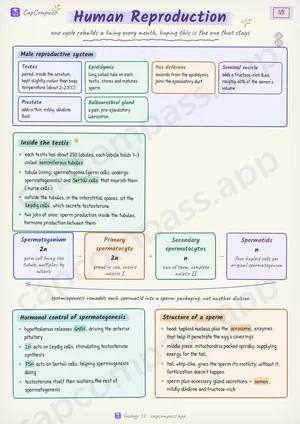
Male reproductive system
- Testes: paired, inside the scrotum, kept slightly cooler than body temperature (about 2-2.5°C)
- Epididymis: long coiled tube on each testis, stores and matures sperm
- Vas deferens: ascends from the epididymis, joins the ejaculatory duct
- Seminal vesicle: adds a fructose-rich fluid, roughly 60% of the semen's volume
- Prostate: adds a thin, milky, alkaline fluid
- Bulbourethral gland: a pair, pre-ejaculatory lubrication
Inside the testis
- each testis has about 250 lobules; each lobule holds 1-3 coiled seminiferous tubules
- tubule lining: spermatogonia (germ cells, undergo spermatogenesis) and Sertoli cells that nourish them ('nurse cells')
- outside the tubules, in the interstitial spaces, sit the Leydig cells, which secrete testosterone
- two jobs at once: sperm production inside the tubules, hormone production between them
- Spermatogonium: germ cell lining the tubule, multiplies by mitosis
- Primary spermatocyte: grows in size, enters meiosis I
- Secondary spermatocytes: two of them, complete meiosis II
- Spermatids: four haploid cells per original spermatogonium
Hormonal control of spermatogenesis
- hypothalamus releases GnRH, driving the anterior pituitary
- LH acts on Leydig cells, stimulating testosterone synthesis
- FSH acts on Sertoli cells, helping spermiogenesis along
- testosterone itself then sustains the rest of spermatogenesis
Structure of a sperm
- head: haploid nucleus plus the acrosome, enzymes that help it penetrate the egg's coverings
- middle piece: mitochondria packed spirally, supplying energy for the tail
- tail: whip-like, gives the sperm its motility; without it, fertilization doesn't happen
- sperm plus accessory gland secretions = semen, mildly alkaline and fructose-rich
Page 1 of 5. The full sheet, all 5 pages, opens free in the app.
What this Human Reproduction sheet covers
- Gametogenesis
- Male reproductive system
- Testes
- Epididymis
- Vas deferens
- Seminal vesicle
- Prostate
- Bulbourethral gland
- Inside the testis
- Spermatogonium
- Primary spermatocyte
- Secondary spermatocytes
- Spermatids
- Hormonal control of spermatogenesis
- Structure of a sperm
- Female reproductive system
- Ovaries
- Fallopian tube
- Uterus
- Cervix
- Vagina
- Oogenesis
- Ovary and the growing follicle
- Spermatogenesis vs Oogenesis
- Spermatogenesis
- The menstrual cycle, phase by phase
- Menstrual phase
- Follicular phase
- Ovulatory phase
- Luteal phase
- Ovarian cycle vs Uterine cycle
- Ovarian cycle
- Uterine cycle
- Hormone levels through the cycle
- Fertilisation and Development
- Fertilization and the first divisions
- Implantation
- The placenta
- hCG and the hormones of pregnancy
- Parturition and lactation
- Full-term signals
- Oxytocin surge
- Parturition
- Lactation
- Reading a cycle from its hormones
- Traps that cost marks
- Tricks that save time
How CapCompass uses this sheet
These notes are not a standalone PDF. CapCompass plans Biology chapter by chapter against your real exam dates and free hours, and when the plan reaches Human Reproduction the sheet opens inside the study block itself — at the page covering the sub-topic that block is on, with the timer still running. Revision arrives at the moment the plan says revise, instead of having to be gone looking for.
More Biology Class 12 revision notes
- Biodiversity and Conservation
- Biotechnology and its Applications
- Biotechnology: Principles and Processes
- Ecosystem
- Evolution
- Human Health and Disease
- Microbes in Human Welfare
- Molecular Basis of Inheritance
- Organisms and Populations
- Principles of Inheritance and Variation
- Reproductive Health
- Sexual Reproduction in Flowering Plants