Molecular Basis of Inheritance — Class 12 CBSE Biology revision notes
A 6-page visual revision sheet for Molecular Basis of Inheritance, written for Class 12 CBSE Biology. Formulas, diagrams and the traps that cost marks, laid out to be read the night before rather than the term before. Free, and it opens inside CapCompass.
 Page 1 as PDF
Molecular Basis of Inheritance in one look
a double helix that copies itself, reads itself, and packs itself away
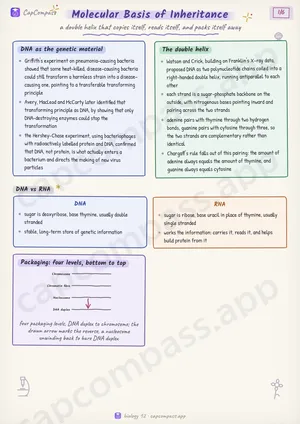
DNA as the genetic material
- Griffith's experiment on pneumonia-causing bacteria showed that some heat-killed, disease-causing bacteria could still transform a harmless strain into a disease-causing one, pointing to a transferable transforming principle
- Avery, MacLeod and McCarty later identified that transforming principle as DNA, by showing that only DNA-destroying enzymes could stop the transformation
- the Hershey-Chase experiment, using bacteriophages with radioactively labelled protein and DNA, confirmed that DNA, not protein, is what actually enters a bacterium and directs the making of new virus particles
The double helix
- Watson and Crick, building on Franklin's X-ray data, proposed DNA as two polynucleotide chains coiled into a right-handed double helix, running antiparallel to each other
- each strand is a sugar-phosphate backbone on the outside, with nitrogenous bases pointing inward and pairing across the two strands
- adenine pairs with thymine through two hydrogen bonds, guanine pairs with cytosine through three, so the two strands are complementary rather than identical
- Chargaff's rule falls out of this pairing: the amount of adenine always equals the amount of thymine, and guanine always equals cytosine
DNA vs RNA
- sugar is deoxyribose, base thymine, usually double stranded
- stable, long-term store of genetic information
- sugar is ribose, base uracil in place of thymine, usually single stranded
- works the information: carries it, reads it, and helps build protein from it
Page 1 of 6. The full sheet, all 6 pages, opens free in the app.
What this Molecular Basis of Inheritance sheet covers
- DNA as the genetic material
- The double helix
- DNA vs RNA
- DNA
- RNA
- Packaging: four levels, bottom to top
- Semiconservative replication
- How much of the original survives
- Replication, one round
- Origin
- Unwinding
- Primer laid
- Strand extended
- Fragments joined
- Leading strand and lagging strand
- The transcription unit
- hnRNA processing in eukaryotes
- Template strand vs Coding strand
- Template strand
- Coding strand
- RNA, sorted by job
- The genetic code
- Reading a short mRNA sequence
- tRNA, the adaptor molecule
- Where gene expression can be controlled
- The lac operon
- Is lactose around?
- Human Genome Project and DNA fingerprinting
- Traps that cost marks
- Tricks that save time
How CapCompass uses this sheet
These notes are not a standalone PDF. CapCompass plans Biology chapter by chapter against your real exam dates and free hours, and when the plan reaches Molecular Basis of Inheritance the sheet opens inside the study block itself — at the page covering the sub-topic that block is on, with the timer still running. Revision arrives at the moment the plan says revise, instead of having to be gone looking for.
More Biology Class 12 revision notes
- Biodiversity and Conservation
- Biotechnology and its Applications
- Biotechnology: Principles and Processes
- Ecosystem
- Evolution
- Human Health and Disease
- Human Reproduction
- Microbes in Human Welfare
- Organisms and Populations
- Principles of Inheritance and Variation
- Reproductive Health
- Sexual Reproduction in Flowering Plants