Microbes in Human Welfare — Class 12 CBSE Biology revision notes
A 6-page visual revision sheet for Microbes in Human Welfare, written for Class 12 CBSE Biology. Formulas, diagrams and the traps that cost marks, laid out to be read the night before rather than the term before. Free, and it opens inside CapCompass.
 Page 1 as PDF
Microbes in Human Welfare in one look
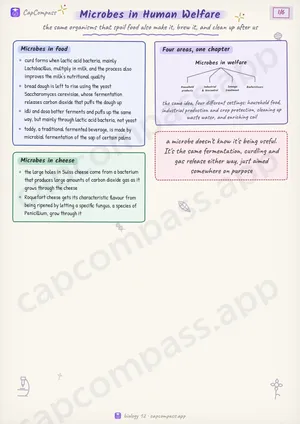
the same organisms that spoil food also make it, brew it, and clean up after us
Microbes in food
- curd forms when lactic acid bacteria, mainly Lactobacillus, multiply in milk, and the process also improves the milk's nutritional quality
- bread dough is left to rise using the yeast Saccharomyces cerevisiae, whose fermentation releases carbon dioxide that puffs the dough up
- idli and dosa batter ferments and puffs up the same way, but mainly through lactic acid bacteria, not yeast
- toddy, a traditional fermented beverage, is made by microbial fermentation of the sap of certain palms
Microbes in cheese
- the large holes in Swiss cheese come from a bacterium that produces large amounts of carbon dioxide gas as it grows through the cheese
- Roquefort cheese gets its characteristic flavour from being ripened by letting a specific fungus, a species of Penicillium, grow through it
Page 1 of 6. The full sheet, all 6 pages, opens free in the app.
What this Microbes in Human Welfare sheet covers
- Microbes in food
- Microbes in cheese
- Four areas, one chapter
- Fermented beverages
- A fermenting vat
- Antibiotics
- Industrial products from microbes
- Citric acid
- Acetic acid
- Lactic acid
- Lipases
- Pectinases and proteases
- Statins
- Biocontrol agents
- Which biocontrol agent fits the problem?
- Biofertilisers, by kind
- Biofertilisers in detail
- Biofertilisers vs Chemical fertilisers
- Biofertilisers
- Chemical fertilisers
- Sewage treatment, primary and secondary
- BOD, falling through treatment
- Sludge and biogas
- Traps that cost marks
- Tricks that save time
How CapCompass uses this sheet
These notes are not a standalone PDF. CapCompass plans Biology chapter by chapter against your real exam dates and free hours, and when the plan reaches Microbes in Human Welfare the sheet opens inside the study block itself — at the page covering the sub-topic that block is on, with the timer still running. Revision arrives at the moment the plan says revise, instead of having to be gone looking for.
More Biology Class 12 revision notes
- Biodiversity and Conservation
- Biotechnology and its Applications
- Biotechnology: Principles and Processes
- Ecosystem
- Evolution
- Human Health and Disease
- Human Reproduction
- Molecular Basis of Inheritance
- Organisms and Populations
- Principles of Inheritance and Variation
- Reproductive Health
- Sexual Reproduction in Flowering Plants