Data Handling and Operators — Class 11 CBSE Computer Science revision notes
A 3-page visual revision sheet for Data Handling and Operators, written for Class 11 CBSE Computer Science. Formulas, diagrams and the traps that cost marks, laid out to be read the night before rather than the term before. Free, and it opens inside CapCompass.
 Page 1 as PDF
Data Handling and Operators in one look
which values can be changed in place, and what every operator actually does to them
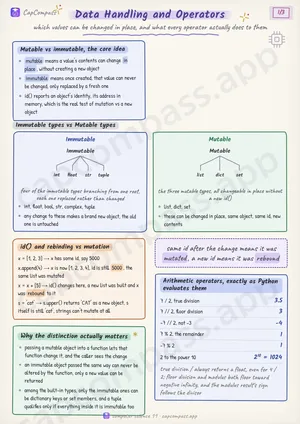
Mutable vs immutable, the core idea
- mutable means a value's contents can change in place, without creating a new object
- immutable means once created, that value can never be changed, only replaced by a fresh one
- id() reports an object's identity, its address in memory, which is the real test of mutation vs a new object
Immutable types vs Mutable types
- int, float, bool, str, complex, tuple
- any change to these makes a brand new object, the old one is untouched
- list, dict, set
- these can be changed in place, same object, same id, new contents
id() and rebinding vs mutation
- x = [1, 2, 3] → x has some id, say 5000
- x.append(4) → x is now [1, 2, 3, 4], id is still 5000, the same list was mutated
- x = x + [5] → id() changes here, a new list was built and x was rebound to it
- s = 'cat' → s.upper() returns 'CAT' as a new object, s itself is still 'cat', strings can't mutate at all
Why the distinction actually matters
- passing a mutable object into a function lets that function change it, and the caller sees the change
- an immutable object passed the same way can never be altered by the function, only a new value can be returned
- among the built-in types, only the immutable ones can be dictionary keys or set members, and a tuple qualifies only if everything inside it is immutable too
Arithmetic operators, exactly as Python evaluates them
- 7 / 2, true division
3.5 - 7 // 2, floor division
3 - -7 // 2, not -3
-4 - 7 % 2, the remainder
1 - -7 % 2
1 - 2 to the power 10
2^10 = 1024
Page 1 of 3. The full sheet, all 3 pages, opens free in the app.
What this Data Handling and Operators sheet covers
- Mutable vs immutable, the core idea
- Immutable types vs Mutable types
- Immutable
- Mutable
- id() and rebinding vs mutation
- Why the distinction actually matters
- Arithmetic operators, exactly as Python evaluates them
- 7 / 2, true division
- 7 // 2, floor division
- -7 // 2, not -3
- 7 % 2, the remainder
- -7 % 2
- 2 to the power 10
- Relational operators
- Logical operators: and, or, not
- and / or return an operand, not a boolean
- 3 and 5
- 0 and 5
- 3 or 5
- 0 or 5
- not 0
- Why and / or hand back a value, not True or False
- Precedence ladder, top to bottom
- 1. parentheses
- 2. power
- 3. unary plus, minus
- 4. multiply, divide, floor divide, modulus
- 5. add, subtract
- 6. comparisons
- 7. not, then and, then or
- Type conversion, implicit vs explicit
- Expression evaluation, worked
- 10 + 3 * 2
- (10 + 3) * 2
- 2 + 3 == 5
- int('7') + 3
- str(5) + '5'
- Terms that show up as one-liners
- Traps that cost marks
- Tricks that save time
How CapCompass uses this sheet
These notes are not a standalone PDF. CapCompass plans Computer Science chapter by chapter against your real exam dates and free hours, and when the plan reaches Data Handling and Operators the sheet opens inside the study block itself — at the page covering the sub-topic that block is on, with the timer still running. Revision arrives at the moment the plan says revise, instead of having to be gone looking for.