Society, Law and Ethics — Class 11 CBSE Computer Science revision notes
A 3-page visual revision sheet for Society, Law and Ethics, written for Class 11 CBSE Computer Science. Formulas, diagrams and the traps that cost marks, laid out to be read the night before rather than the term before. Free, and it opens inside CapCompass.
 Page 1 as PDF
Society, Law and Ethics in one look
what a responsible user of technology owes to everyone else who shares the same network
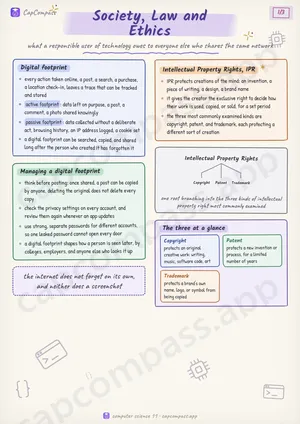
Digital footprint
- every action taken online, a post, a search, a purchase, a location check-in, leaves a trace that can be tracked and stored
- active footprint: data left on purpose, a post, a comment, a photo shared knowingly
- passive footprint: data collected without a deliberate act, browsing history, an IP address logged, a cookie set
- a digital footprint can be searched, copied, and shared long after the person who created it has forgotten it
Managing a digital footprint
- think before posting: once shared, a post can be copied by anyone, deleting the original does not delete every copy
- check the privacy settings on every account, and review them again whenever an app updates
- use strong, separate passwords for different accounts, so one leaked password cannot open every door
- a digital footprint shapes how a person is seen later, by colleges, employers, and anyone else who looks it up
Intellectual Property Rights, IPR
- IPR protects creations of the mind: an invention, a piece of writing, a design, a brand name
- it gives the creator the exclusive right to decide how their work is used, copied, or sold, for a set period
- the three most commonly examined kinds are copyright, patent, and trademark, each protecting a different sort of creation
The three at a glance
- Copyright: protects an original creative work: writing, music, software code, art
- Patent: protects a new invention or process, for a limited number of years
- Trademark: protects a brand's own name, logo, or symbol from being copied
Page 1 of 3. The full sheet, all 3 pages, opens free in the app.
What this Society, Law and Ethics sheet covers
- Digital footprint
- Managing a digital footprint
- Intellectual Property Rights, IPR
- The three at a glance
- Copyright
- Patent
- Trademark
- Open source software and licensing
- Open source vs Proprietary
- Open source
- Proprietary
- Plagiarism
- Cybercrime, the common kinds
- Staying safe
- E-waste and the IT Act
- Terms that show up as one-liners
- Traps that cost marks
- Tricks that save time
How CapCompass uses this sheet
These notes are not a standalone PDF. CapCompass plans Computer Science chapter by chapter against your real exam dates and free hours, and when the plan reaches Society, Law and Ethics the sheet opens inside the study block itself — at the page covering the sub-topic that block is on, with the timer still running. Revision arrives at the moment the plan says revise, instead of having to be gone looking for.