Quadratic Equations — Class 10 Maharashtra SSC Mathematics revision notes
A 5-page visual revision sheet for Quadratic Equations, written for Class 10 Maharashtra SSC Mathematics. Formulas, diagrams and the traps that cost marks, laid out to be read the night before rather than the term before. Free, and it opens inside CapCompass.
 Page 1 as PDF
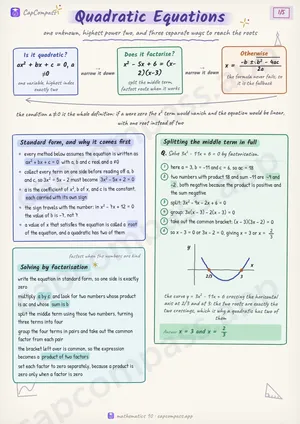
Quadratic Equations in one look
one unknown, highest power two, and three separate ways to reach the roots
- Is it quadratic?: one variable, highest index exactly two
- Does it factorise?: split the middle term, fastest route when it works
- Otherwise: the formula never fails, so it is the fallback
Standard form, and why it comes first
- every method below assumes the equation is written as ax^2 + bx + c = 0 with a, b and c real and a ≠ 0
- collect every term on one side before reading off a, b and c, so 3x^2 = 5x - 2 must become 3x^2 - 5x + 2 = 0
- a is the coefficient of x^2, b of x, and c is the constant, each carried with its own sign
- the sign travels with the number: in x^2 - 7x + 12 = 0 the value of b is -7, not 7
- a value of x that satisfies the equation is called a root of the equation, and a quadratic has two of them
Solving by factorisation
- write the equation in standard form, so one side is exactly zero
- multiply a by c and look for two numbers whose product is ac and whose sum is b
- split the middle term using those two numbers, turning three terms into four
- group the four terms in pairs and take out the common factor from each pair
- the bracket left over is common, so the expression becomes a product of two factors
- set each factor to zero separately, because a product is zero only when a factor is zero
Splitting the middle term in full
Q. Solve 3x^2 - 11x + 6 = 0 by factorisation.
- here a = 3, b = -11 and c = 6, so ac = 18
- two numbers with product 18 and sum -11 are -9 and -2, both negative because the product is positive and the sum negative
- split: 3x^2 - 9x - 2x + 6 = 0
- group: 3x(x - 3) - 2(x - 3) = 0
- take out the common bracket: (x - 3)(3x - 2) = 0
- so x - 3 = 0 or 3x - 2 = 0, giving x = 3 or x = 2/3
Answer: x = 3 and x = 2/3
Page 1 of 5. The full sheet, all 5 pages, opens free in the app.
What this Quadratic Equations sheet covers
- Is it quadratic?
- Does it factorise?
- Otherwise
- Quadratic equation
- Standard form
- Standard form, and why it comes first
- Factorisation method
- Splitting the middle term
- Solving by factorisation
- Splitting the middle term in full
- Completing the square
- Quadratic formula
- Completing the square, and where the formula comes from
- The three results worth memorising
- the roots of ax^2 + bx + c = 0
- the discriminant, written as capital delta
- sum of the roots
- product of the roots
- rebuilding an equation from its roots
- Reading the sum and product straight off
- Nature of roots
- Discriminant
- What the discriminant tells you before you solve
- Δ > 0
- Δ = 0
- Δ < 0
- Why it works
- Finding an unknown from the nature of the roots
- Application of quadratic equations
- Word problems
- Word problems, and the step that is actually marked
- Rejecting a root, which the marking scheme expects to see
- A full word problem, framing to rejection
- Choosing a method under time pressure
- Factorisation
- The formula
- Symbols in this chapter
- Traps that cost marks
- Tricks that save time
How CapCompass uses this sheet
These notes are not a standalone PDF. CapCompass plans Mathematics chapter by chapter against your real exam dates and free hours, and when the plan reaches Quadratic Equations the sheet opens inside the study block itself — at the page covering the sub-topic that block is on, with the timer still running. Revision arrives at the moment the plan says revise, instead of having to be gone looking for.