Anatomy of Flowering Plants — Class 11 CBSE Biology revision notes
A 4-page visual revision sheet for Anatomy of Flowering Plants, written for Class 11 CBSE Biology. Formulas, diagrams and the traps that cost marks, laid out to be read the night before rather than the term before. Free, and it opens inside CapCompass.
 Page 1 as PDF
Anatomy of Flowering Plants in one look
the internal tissues behind every root, stem and leaf
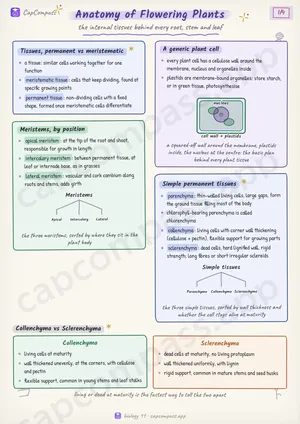
Tissues, permanent vs meristematic
- a tissue: similar cells working together for one function
- meristematic tissue: cells that keep dividing, found at specific growing points
- permanent tissue: non-dividing cells with a fixed shape, formed once meristematic cells differentiate
Meristems, by position
- apical meristem: at the tip of the root and shoot, responsible for growth in length
- intercalary meristem: between permanent tissue, at leaf or internode base, as in grasses
- lateral meristem: vascular and cork cambium along roots and stems, adds girth
A generic plant cell
- every plant cell has a cellulose wall around the membrane, nucleus and organelles inside
- plastids are membrane-bound organelles: store starch, or in green tissue, photosynthesise
Simple permanent tissues
- parenchyma: thin-walled living cells, large gaps, form the ground tissue filling most of the body
- chlorophyll-bearing parenchyma is called chlorenchyma
- collenchyma: living cells with corner wall thickening (cellulose + pectin), flexible support for growing parts
- sclerenchyma: dead cells, hard lignified wall, rigid strength; long fibres or short irregular sclereids
Collenchyma vs Sclerenchyma
- living cells at maturity
- wall thickened unevenly, at the corners, with cellulose and pectin
- flexible support, common in young stems and leaf stalks
- dead cells at maturity, no living protoplasm
- wall thickened uniformly, with lignin
- rigid support, common in mature stems and seed husks
Page 1 of 4. The full sheet, all 4 pages, opens free in the app.
What this Anatomy of Flowering Plants sheet covers
- Tissues, permanent vs meristematic
- Meristems, by position
- A generic plant cell
- Simple permanent tissues
- Collenchyma vs Sclerenchyma
- Collenchyma
- Sclerenchyma
- Complex permanent tissues
- The tissue system, an alternative grouping
- Vascular bundle: open vs closed
- Open
- Closed
- Root vs stem xylem, the key flip
- Dicot root: exarch
- Dicot stem: endarch
- Root or stem, from the cross-section
- Secondary growth, growth in girth
- Annual rings: spring wood vs autumn wood
- Symbols
- Traps that cost marks
- Tricks that save time
How CapCompass uses this sheet
These notes are not a standalone PDF. CapCompass plans Biology chapter by chapter against your real exam dates and free hours, and when the plan reaches Anatomy of Flowering Plants the sheet opens inside the study block itself — at the page covering the sub-topic that block is on, with the timer still running. Revision arrives at the moment the plan says revise, instead of having to be gone looking for.
More Biology Class 11 revision notes
- Animal Kingdom
- Biological Classification
- Biomolecules
- Body Fluids and Circulation
- Breathing and Exchange of Gases
- Cell Cycle and Cell Division
- Cell: The Unit of Life
- Chemical Coordination and Integration
- Excretory Products and their Elimination
- Locomotion and Movement
- Morphology of Flowering Plants
- Neural Control and Coordination
- Photosynthesis in Higher Plants
- Plant Growth and Development
- Plant Kingdom
- Respiration in Plants
- Structural Organisation in Animals
- The Living World